
The late Fred Specht may well be regarded by some as the man who put the West Adelaide Basketball Club on the map. But he was much more than that. Beginning as the Kingston Tennis club it later morphed into the West Adelaide Basketball Club.
Initially, with his nephew Dixon (Dick) Bruning, he formed the Kingston Men’s Basketball Club (KMBC) in 1940’s on the Specht’s family-owned Kingston Tennis Club property on Kingston Ave, Richmond. The tennis club was well established with a club house and five outdoor courts but in winter the courts were often too wet to play. It was during one of these periods that Fred Specht, together with his nephew Dixon Bruning, decided they should investigate the game of Men’s Basketball and they visited the Duncan Building to watch the game being played. The tennis players needed something to do to fill in the time and one court was made available for the new KMBC team to practice.
In 1946 the first Kingston Men’s Basketball team was formed to play in the
SAMBA which had recently resumed playing after WW2. The first coach and president of the Kingston Men’s Basketball Club was Fred Specht. He had outstanding success guiding the men’s team to a staggering 4 championships in 5 years. In 1948 and 1949 they won the ‘A’ grade title at the OBI (Our Boys Institute) competition and more premierships in 1951, 52 at the Thebarton Town Hall. Not only was he coaching and undertaking official duties he was also using his own money to buy basketballs and to purchase and build the first wooden backboards for the club.
In 1950 the South Australian Metropolitan Basketball Association (SAMBA) and the OBI had disputes about costs which resulted in the SAMBA breaking away from the OBI to form a new Association which was named District & Metropolitan Amateur Basketball Association. To start the new association, it was decided primarily by Frank Angove, Ted Hunt, and Fred Specht to have an eight (8) team competition and each club involved in the break-away was to assume a League Football Club name. It was considered that football followers would provide increased support for the game hence the name change.
Consequently, after much heated discussion, the Kingston Basketball Club was renamed the West Adelaide Basketball Club. This name was chosen because the Kingston Tennis Club was part of the West Adelaide Football Club area and the Specht family’s allegiance to the team, being red hot supporters. Specht consequently coached WABC to 2 more premierships in DMAB competition now located at the Thebarton Town Hall.
In 1953 the ‘A’ Grade competition moved from the Thebarton Town Hall to the new Forestville Stadium. This was a milestone in Australia as it was the first stadium purpose built for basketball. Angove, Hunt, Merv Harris and Specht, four stalwarts of SA basketball had dreamed of this moment and the time when all clubs would have their own stadium. To pursue this dream, (much against his wife’s wishes) Specht and players of the time became original debenture share investors to raise the 3000 pounds needed to build the stadium. Late in that year he moved from West Adelaide to South Adelaide to further continue his coaching career as their ‘A’ grade coach. From there more coaching opportunities arose with West Torrens ‘A’ grade teams and so he moved on.
Specht is best remembered as an administrator and an official and that is no surprise given his achievements. He became the first vice-president of the DAMBA, a position he held for an amazing 25 years (1950-75), when he retired due to ill health. As a result of an increase in junior basketballers playing the game at the new Forestville Stadium, he established a junior committee to oversee its development. He became the first president of the Junior Committee and held this position from 1953-1975. He set up the junior competitions from their infancy and was considered ‘the father of junior basketball’ in those years.
Even though he coached a variety of teams, he managed even more. He managed or coached a host of U/16 and U/18 State teams during his presidency of Junior basketball in South Australia. From senior state teams at Australian Championships to touring to New Zealand with State and combined District teams in the 1960’s, nothing was too much for him.
A fact not well known is Specht also had a hand in establishing the site of the Apollo Stadium. In the late 1960’s the DAMBA were looking for land to build a new headquarters. Fred, on his daily walks around his Richmond neighbourhood, discovered an unused block of land on Kingston Avenue. On making enquiries Specht discovered the CMV motor vehicle company had intended selling it as it no longer served their purposes. He contacted his old friend Frank Angove about the site, discussions and negotiations took place between Angove and the managing director of the car company and the site was bought. The rest is history. Fred Specht loved the site as it was only 5 minutes from his house!
Fred Specht was a pioneer of basketball in South Australia. From his beginnings in the formation of one of the State’s most powerful clubs, West Adelaide, to his hard work and diligence in the building the Forestville Stadium to his countless years in managing a variety of aspects of manging junior and senior teams he will be remembered as one of the visionaries of our sport.
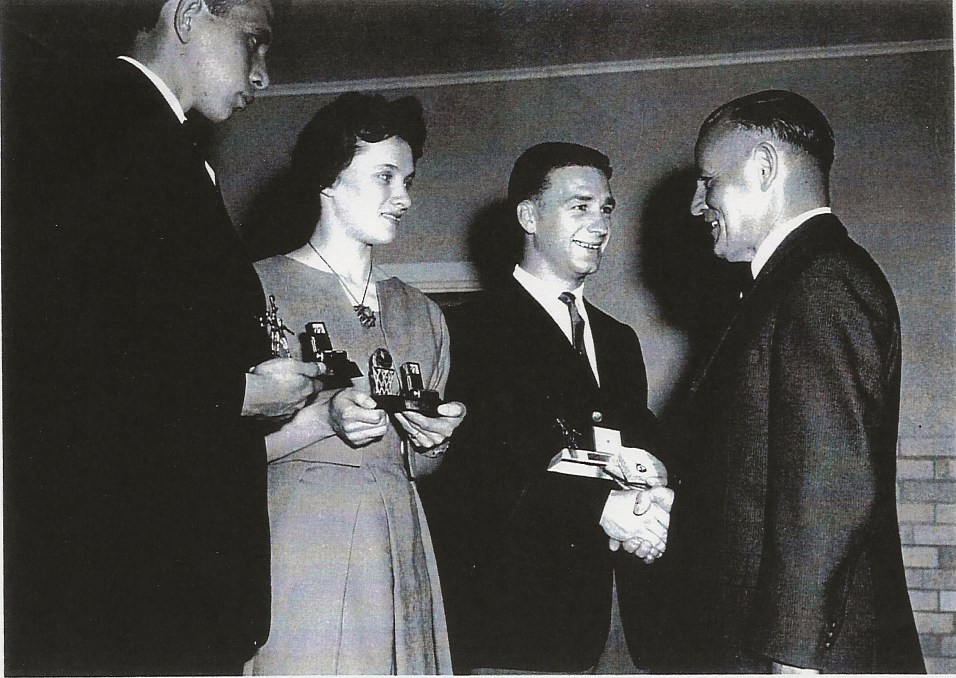
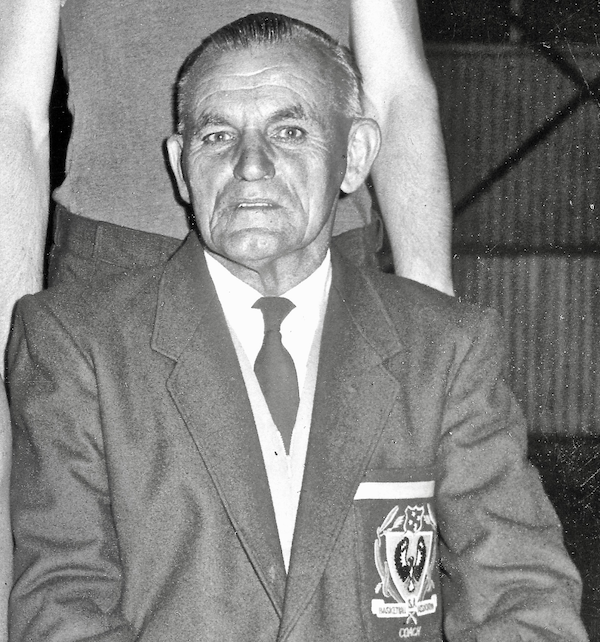
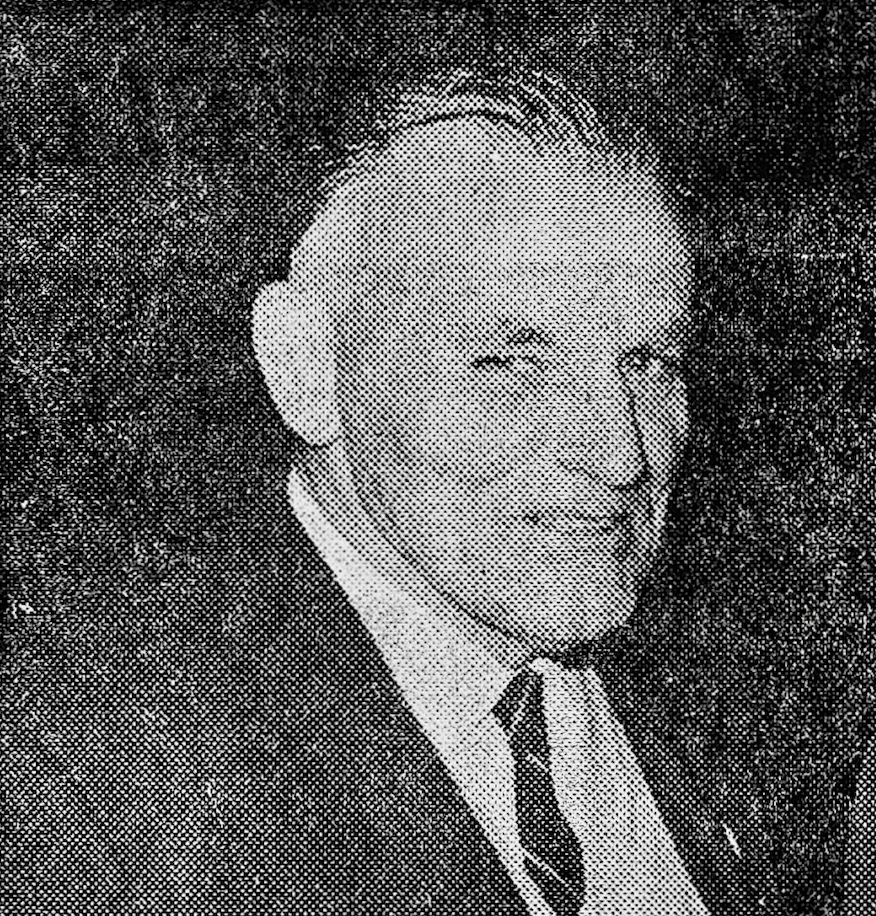
Albert Leslie
Born in Woolloomooloo, NSW Albert quickly became the pride of the town.
Starting in 1960 with the Under 16 NSW State Team, Albert continued to represent NSW consecutively until 1964 in the Senior Men’s state team. Returning for one year in 1969.
Albert made the move to South Adelaide’s Men’s team in 1965 where the team took the premiership. Albert’s success with South Australian teams continued representing the SA Senior Men’s State team in 1966 and becoming Australian Champions. Albert returned to the SA Men’s states team in 1967-68 as the Australian Runner-Ups.
Albert won the Kay’s Trophy (highest votes for U20 in the Woollacott medal, now known as the Frank Angove Award) in 1966 with his debut with United Church Men’s team. He continued with United in 1967 winning the Woollacott Medal.
1968 saw Albert make the Australian Olympic Team that went to Mexico for a pre-Olympic tournament. An incredible achievement for the young and tremendously talented player.
Albert returned to his NSW roots representing Sydney YMCA for four consecutive years in 1969, 1970, 1971 and 1972. During this time, he achieved selection in another Australian National Team this time heading to the World Championships in Yugoslavia.
The SA Men’s State Team were graced with the return of Albert in 1973 for the Philippines Tour. This tour gave the SA Men the opportunity to play against the Philippines National Team.
Forestville Eagles Men’s team carried out the final years of Alberts playing career before his venture in the coaching space.
Albert’s coaching style achieved greatness from his players. Utilising his humble demeanour, knowledge, and experience of the game he was able to get the best out of his players. As head coach Albert lead the SA Under 20 Men’s team to Championship in 1986 and stayed on with the team until 1989.
Albert’s coaching success continued with a SEBL Championship as the Head Coach of the Adelaide Buffalos. The completion of his coaching career came with Albert joining the Adelaide 36ers as their Assistant.
Outside of his playing and coaching career Albert has reach phenomenal feats becoming an Adelaide 36ers Life Member, participating in the 2000 Olympics Relay, being the first junior from Woolloomooloo to represent State’s and gain and Olympic selection. Albert is a past secretary of the Olympians club, a Basketball SA Participant Life Member and won two MVP awards as part of the Forestville Eagles.
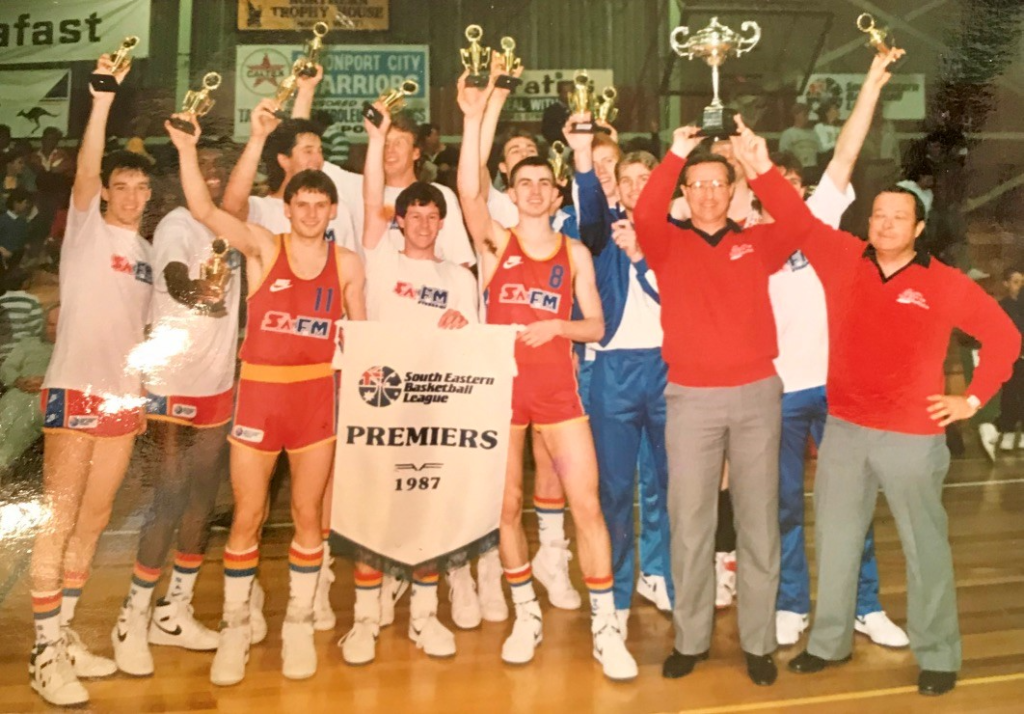
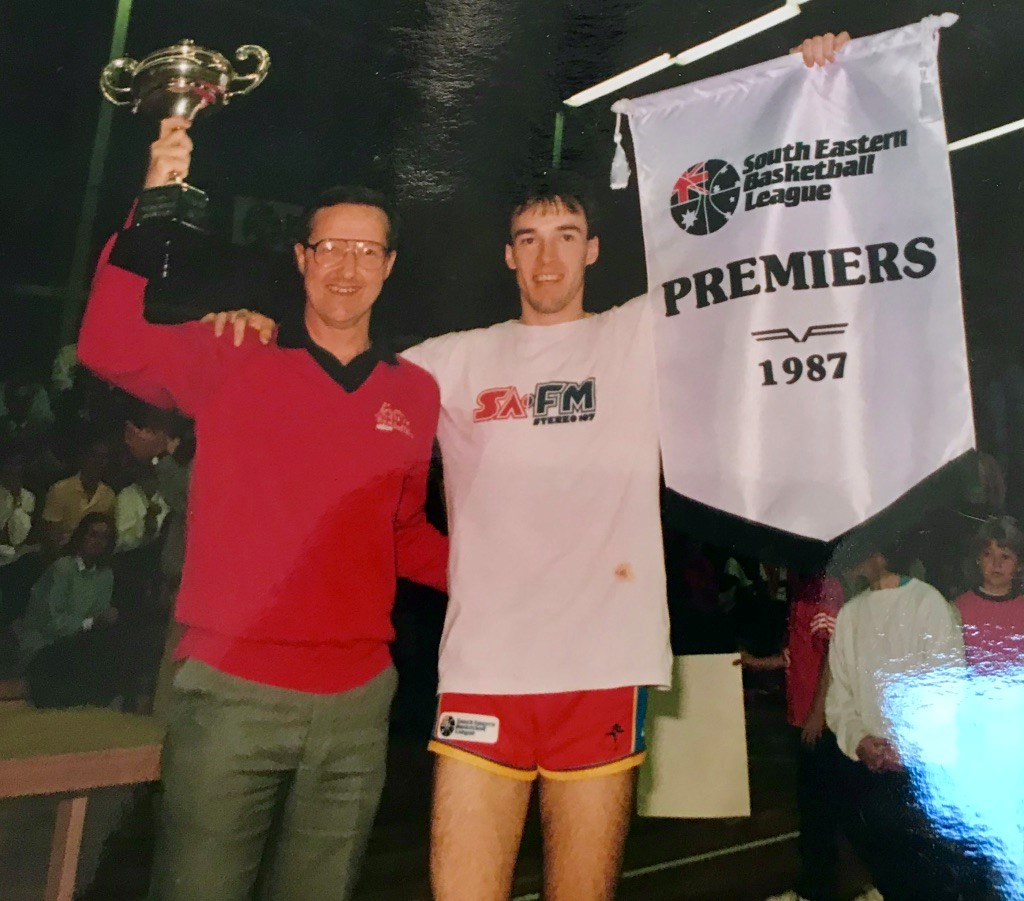
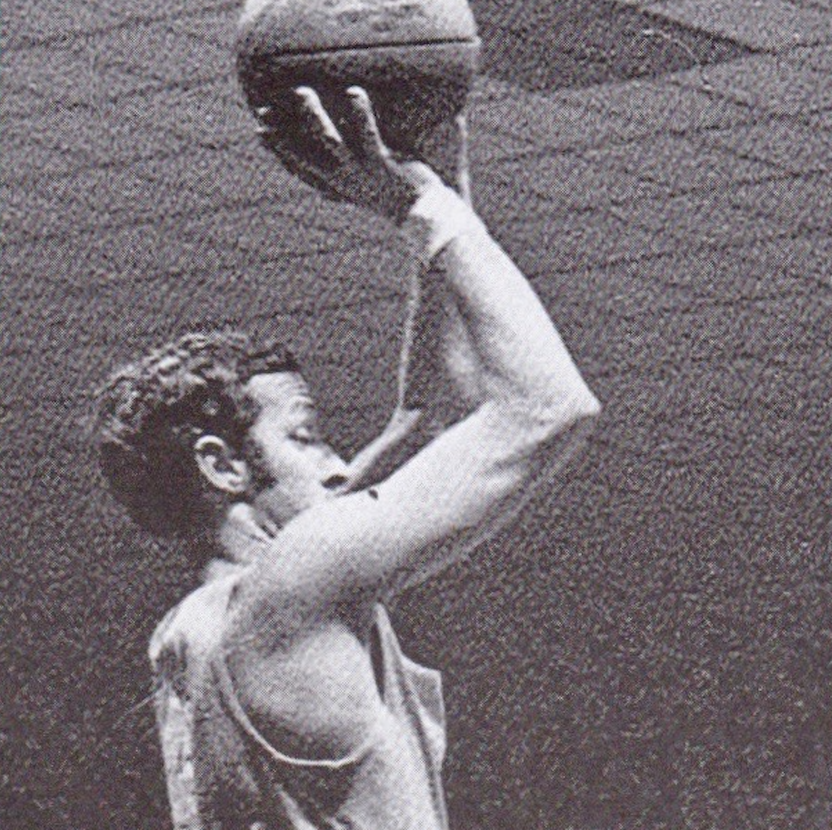
West Adelaide 1982 Mens Team
When West Adelaide Bearcats men’s team hit the hardwood in 1982, it was the culmination of five years of work that produced South Australia’s historic first national club champion.
The National Basketball League (NBL) tipped off in 1979 and the Bearcats were among its inaugural clubs, having won the SA championship in 1978. They would again go on to win in 1979, 1980, 1981 and finally, 1982 – the longest championship winning reign in South Australian basketball history.
Much of this had to do with their American-born playing-coach and inaugural NBL Most Valuable Player, Ken Richardson who arrived in Adelaide in 1974.
In 1975 he created history as the first American to claim the Woollacott Medal as the state’s fairest and most brilliant player. In his era, Richardson was the best player in Australian basketball and his decision to move from a starter’s role to West Adelaide’s sixth man was hugely influential in the Bearcats’ total domination of 1982.
A season-ending injury cost Richardson the 1981 season as a player but continued as coach, West still finished third in the NBL. In his comeback season as a player-coach in 1982, Richardson averaged 14.5ppg at 58.8% (143/243 – #2 in NBL), 6.2rpg, 1.4 apg off the bench, always able to assess what his team might be needing. For example, in the NBL playoffs he led the team in scoring with 25 points in its semi final win, then in rebounding with 11 in the Grand Final.
After losing the 1980 NBL Grand Final to St Kilda Saints and their unstoppable mercurial American guard Rocky Smith, Richardson set out to find a “Rocky of our own”. This led to the recruitment of Al Green.
Out of Louisiana State University, Green was unlike anyone Australian basketball had seen before, a scoring guard with lightning-fast reflexes, moves, skills and jumping ability. “Dr Dunkenstein” had fans filing into Apollo Stadium just to see his sizzling abilities, not to mention his penchant for trash-talk which harkened back to his New York roots. When the naturalised Richardson added Leroy Loggins to the Bearcats’ roster, it had arguably the two most accomplished imports in the NBL.
Green won the Woollacott Medal in 1982 as West Adelaide stormed to its record fifth straight SA championship, smashing Forestville Eagles 97-84 in the Grand Final.
This was West’s 17th Grand Final appearance since 1957, Green also leading the season scoring and securing a rare double by also owning the state league’s best field goal percentage.
At the other end of the floor, Loggins was busy winning the league’s Best Defensive Player award, the dynamic US duo also holding down two spots on the All Star Five (First Team).
West progressively built the irresistible force which culminated in its 1982 superiority. Two of its starters – Peter Ali and Ray Wood – both were products of the club’s junior program.
Ali in 1980 represented Australia at the Olympic Games in Moscow and was a revered defensive player. Wood won the NBL’s Best Defensive Player award twice (1980, 1981) and holds a personal milestone as the only Defensive Player award winner in the league’s history to also have produced a 40-point game. He could play both ends of the floor and was the team’s playmaking general.
Raw-boned NSW-born centre Brad Dalton completed Richardson’s starting quintet, the playing-coach’s eye for talent reinforced with Dalton winning Olympic Games selections for Australia in 1984 and 1988.
Joining Richardson on the bench were State forward and National junior rep Joe Theil and a trio of West Adelaide juniors Trevor Maddiford, Greg Mules and Peter Dawe, the latter representing Australia at Under-20 level.
This unprecedented powerhouse team was the first to include three league MVPs in Richardson, Green and Loggins. The Sydney Kings would field three league MVPs in Andrew Bogut, Kevin Lisch and Jerome Randle in 2019 but did not go on to win a championship.
Green averaged 27.3 points per game at an NBL-leading 59.1 per cent accuracy. The second most accurate player in the NBL was Richardson at 58.8 per cent. Third was Loggins, whose 25.2 ppg were delivered at 56.9 per cent – another yet-to-be repeated feat.
The Bearcats trio also all won Woollacott Medals in SA.
In its dominant NBL season, where run-and-gun backed by amazing defensive commitment but highlighted by touchdown passes out of defence for lay-ups were a regular component. West Adelaide produced a 21-5 win-loss record, an 81% success rate, and averaged 97.1ppg, conceding 83.7ppg, a winning differential of 13.4ppg. Two of its five losses were by one point and a third by two.
Loggins, with a 32-point tour de force, was named MVP of the Grand Final victory over Geelong.
Richardson was assisted by bench coach Mike DeGaris and team manager Keith Woods, completing one of the greatest teams in NBL and SA history – worthy inductees into the Basketball SA Hall of Fame in the “Teams” category.
The 1982 West Adelaide Bearcats consisted of:
Playing Coach, Ken Richardson (dec)
Assistant Coach, Mike Degaris (dec)
Al Green
Leroy Loggins
Peter Ali
Brad Dalton
Ray Wood
Trevor Maddiford
Greg Mules
Peter Dawe
Joel Theil
Garry Thompson
Manager/Trainer, Keith Woods
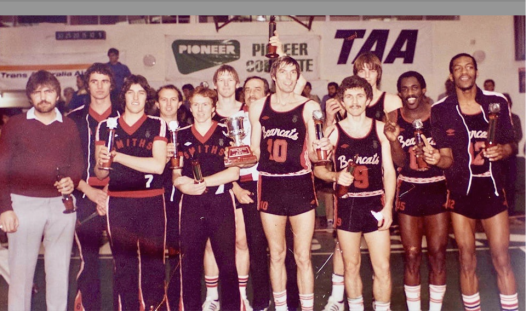
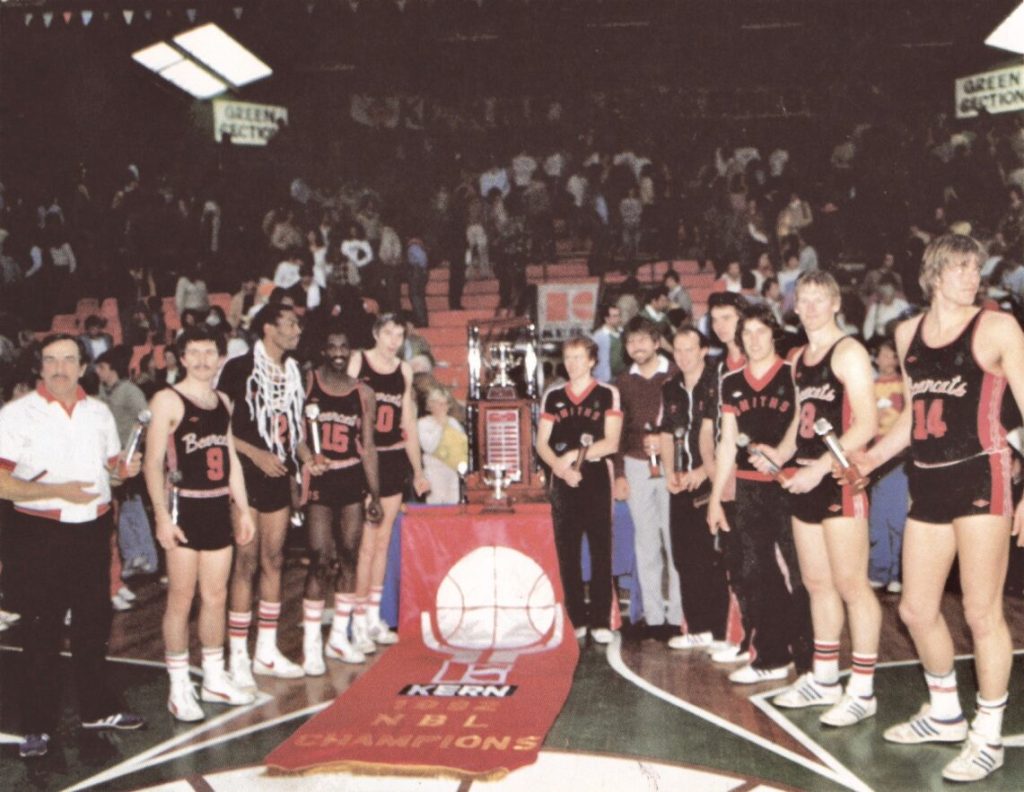
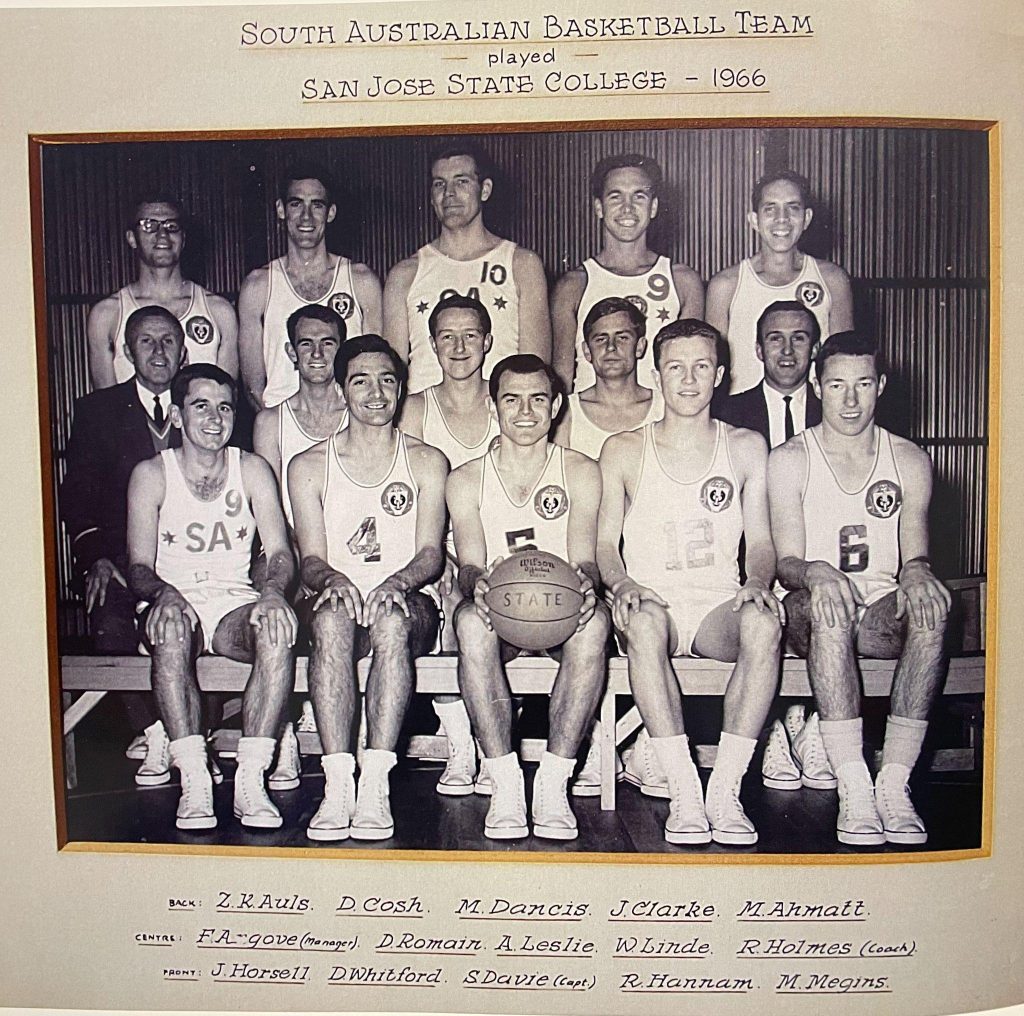
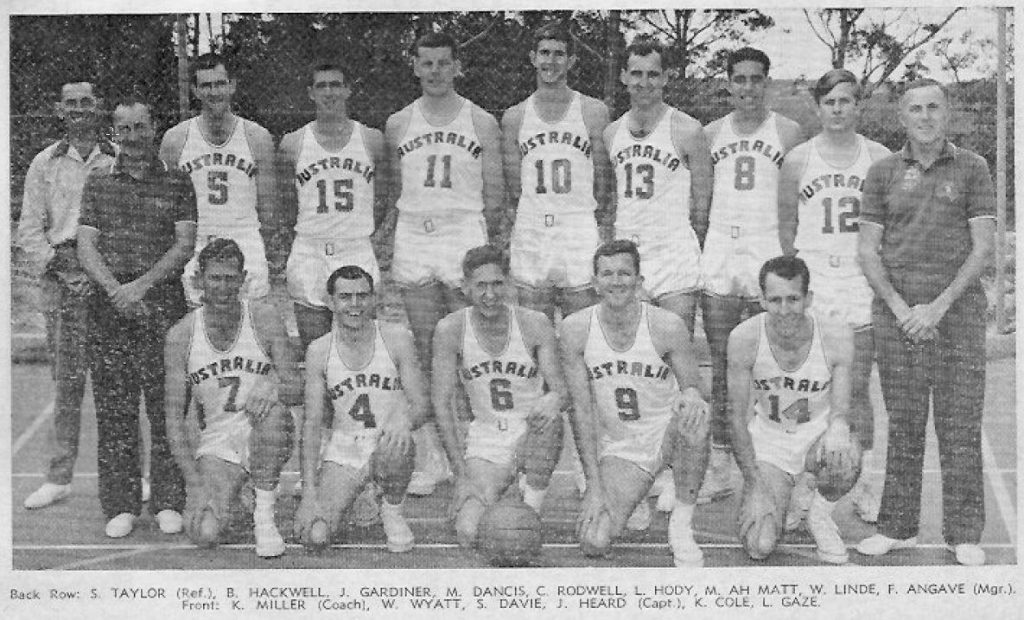
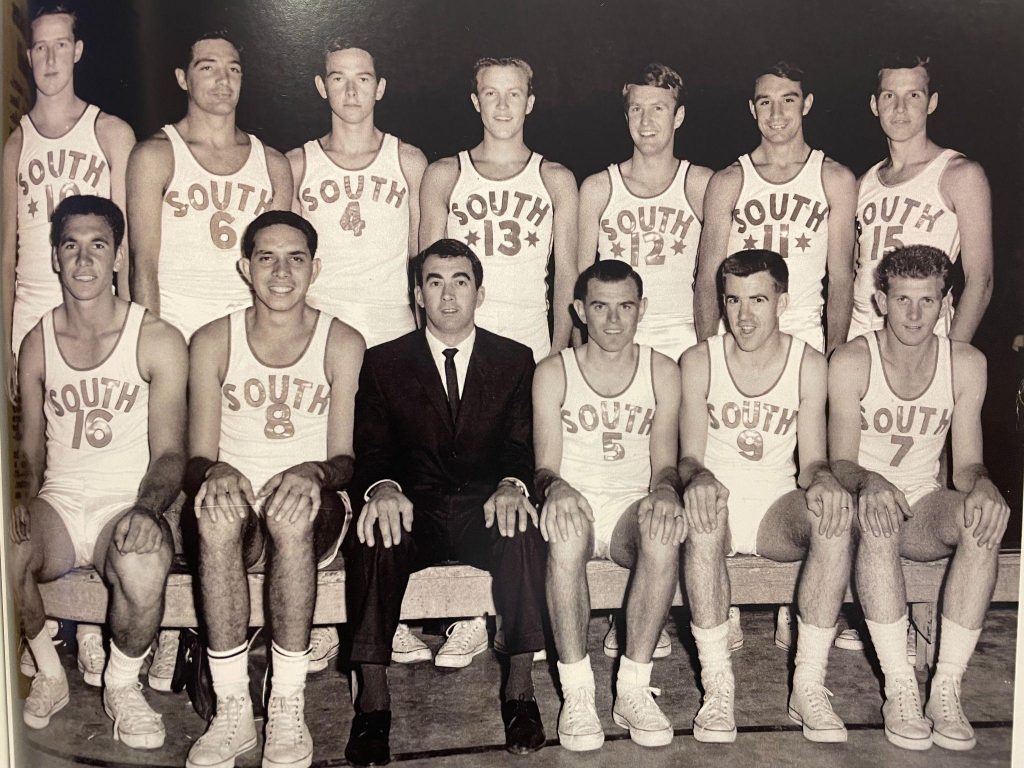
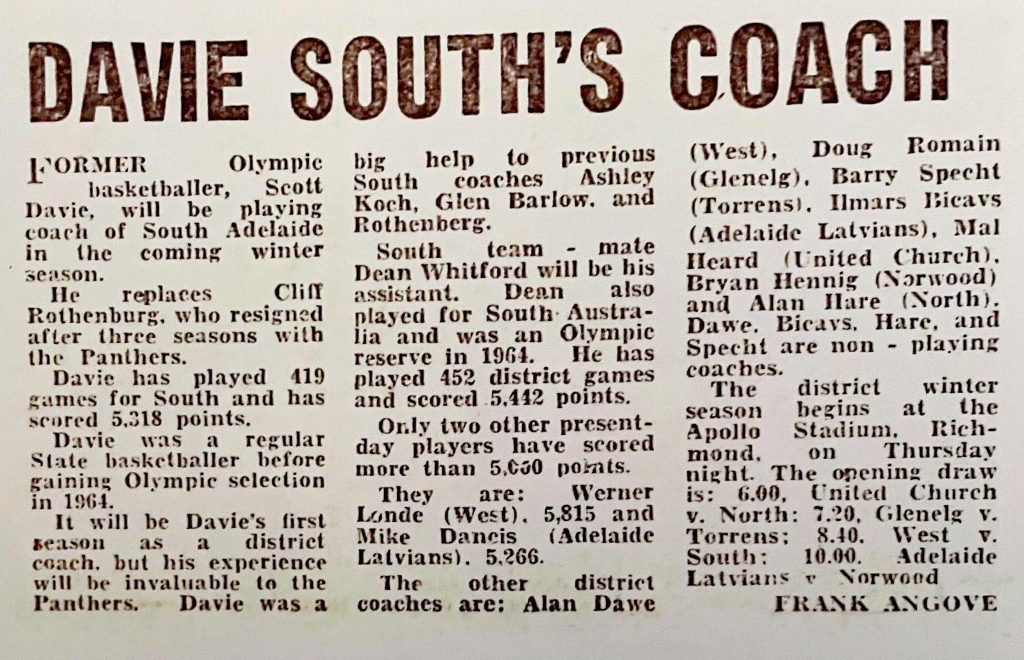
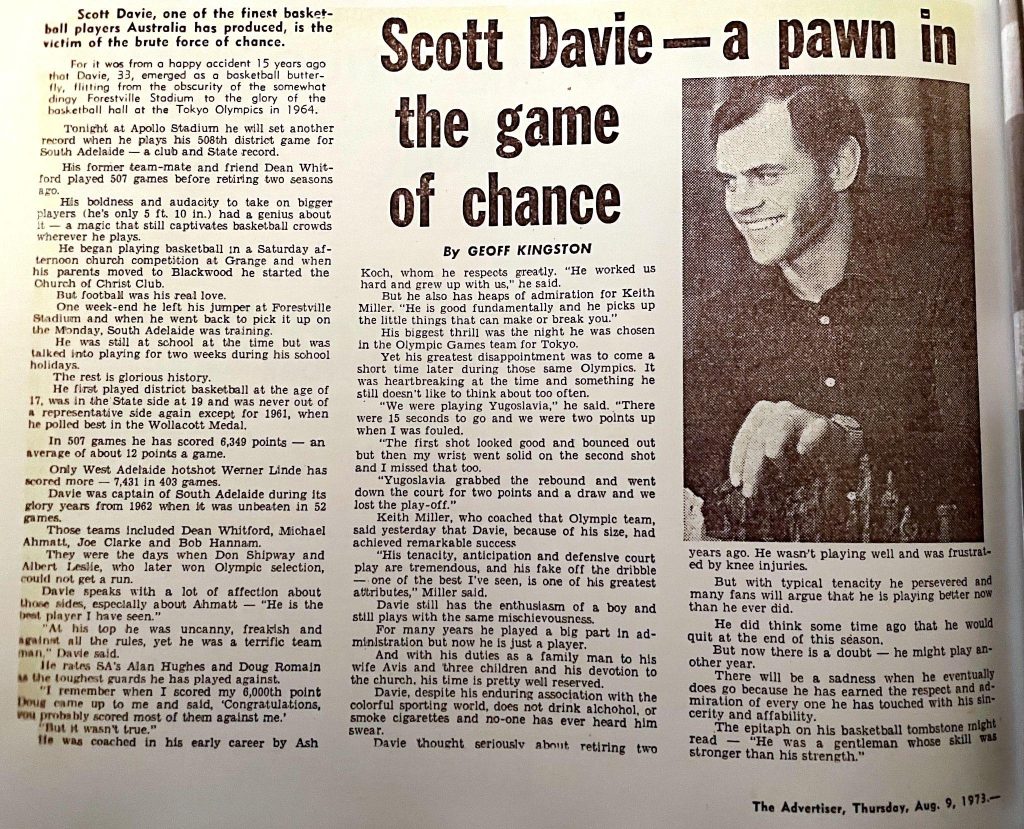
Scott Davie
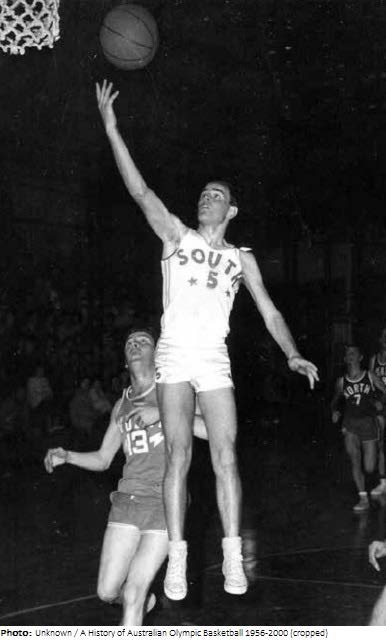
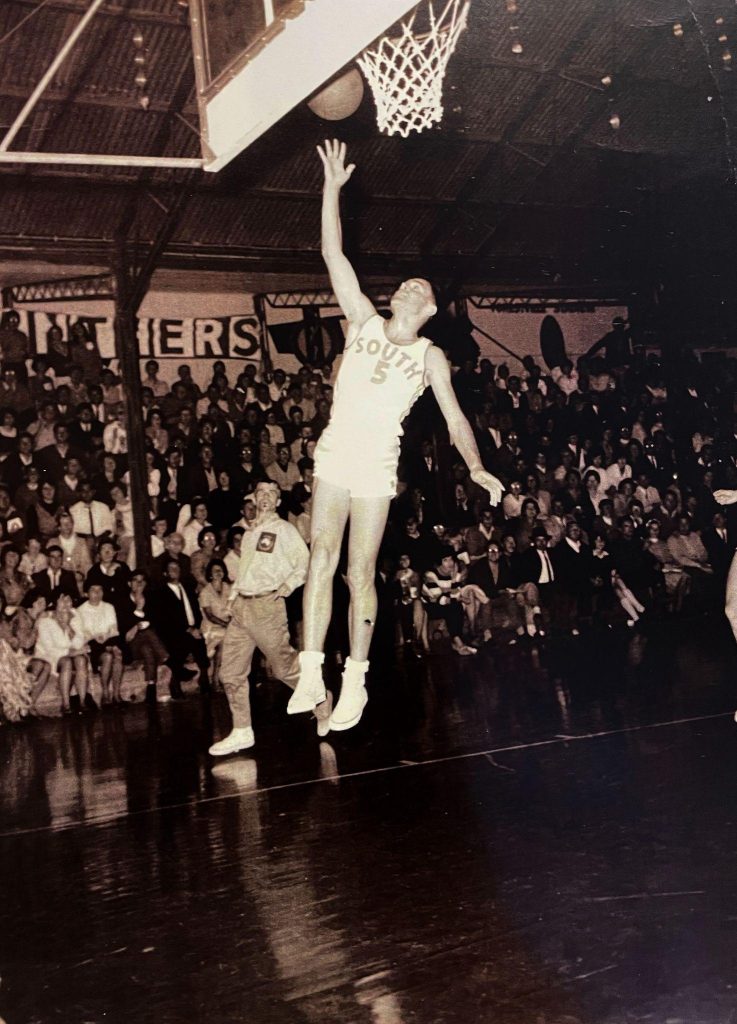
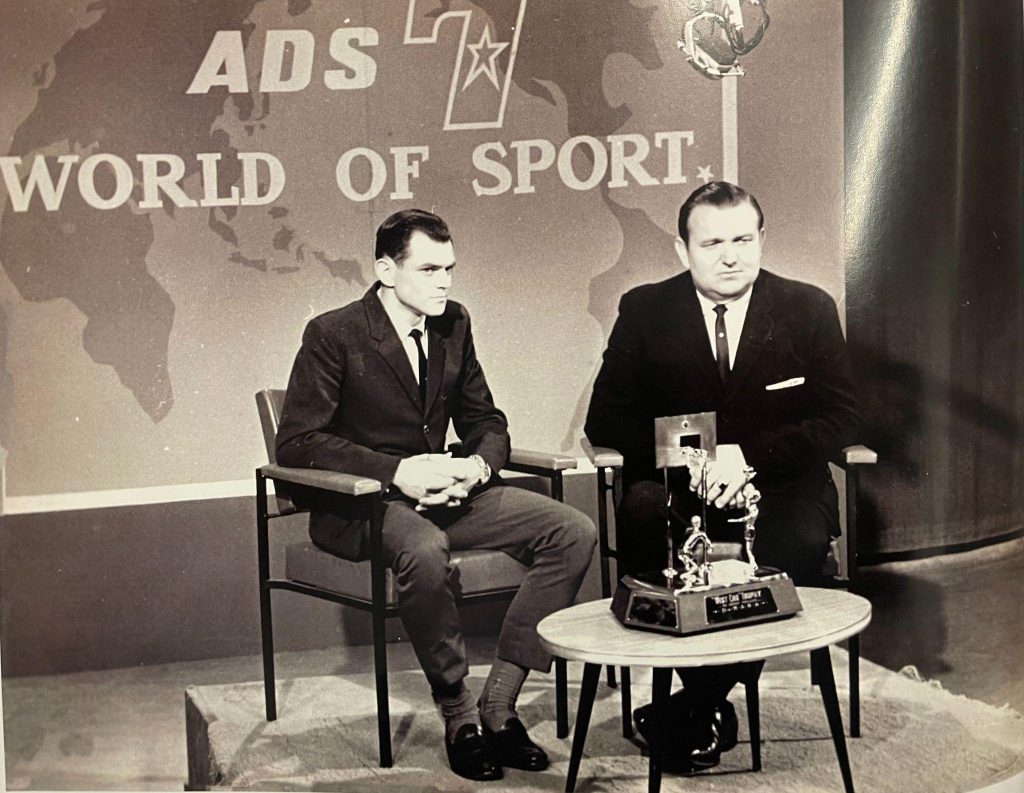
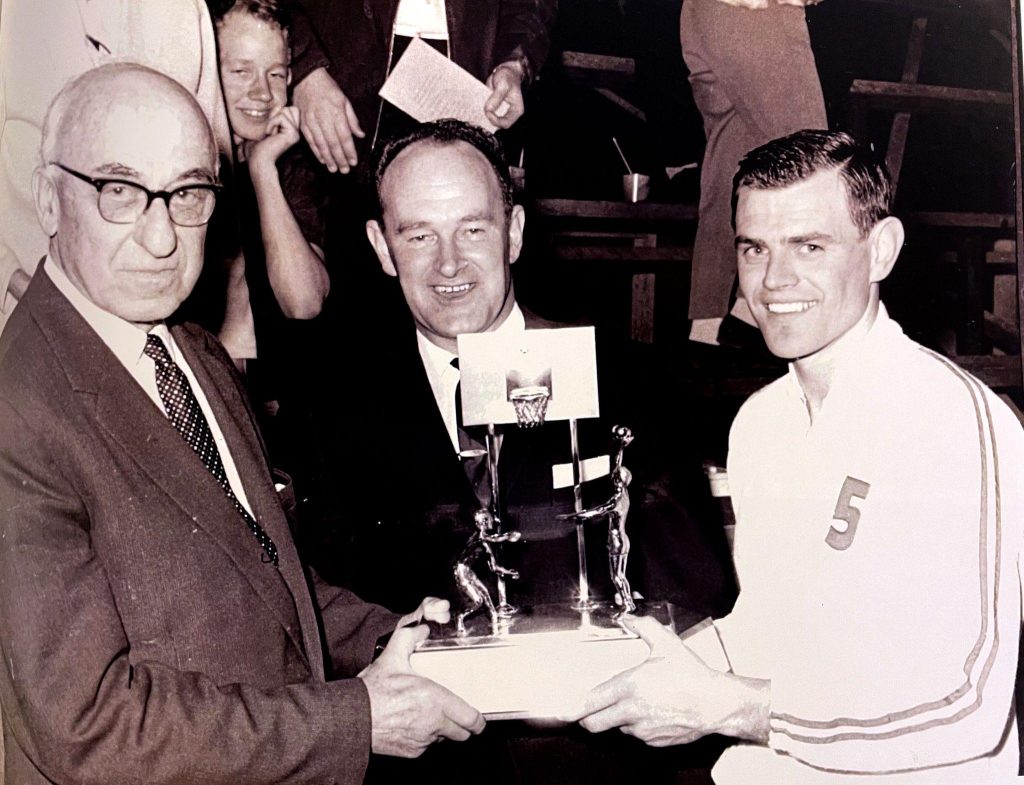
Born Theodore Lisle Scott Davie on 15 February 1940, Scott Davie is a living legend of the South Adelaide Basketball Club. His legacy to the sport in general means his imminent induction into the Basketball SA Hall of Fame long has been a foregone conclusion.
Launching his career as a high-scoring and energetic guard with Grange Christian Centre in 1951 in the Uniting Church Basketball Association, Scott remained true to his church basketball roots well after his many successes at state and international level with South Adelaide, South Australia and Australia.
By 1957, Scott was playing at South Adelaide, elevated to the club’s top team in 1958 where his illustrious career with the Panthers would yield a (then) record 583 senior (or district) games, a record only surpassed by Hall of Famer and South teammate Michael Ahmatt with 588.
Scott is second too in career points scoring 6,349 points as a Panther, behind Hall of Fame legend Werner Linde.
As South Adelaide captain from 1962 to 1972 – including a year as playing-coach in 1970 – he led the club through its “golden era” which included winning a record 52 consecutive matches from 1962.
Scott was instrumental in South Adelaide’s breakthrough inaugural championship in 1963 and subsequent state championship wins in 1965, 1966, 1969 and 1973 before his retirement.
Selected 10 times from 1959 to 1969, to represent South Australia at National States Championships, Scott was a key player in SA winning titles in 1959, 1960, 1963, 1964 and 1965 – five championships in a 10-year period.
He was South Australia’s captain in its 1965, 1966 and 1968 campaigns.
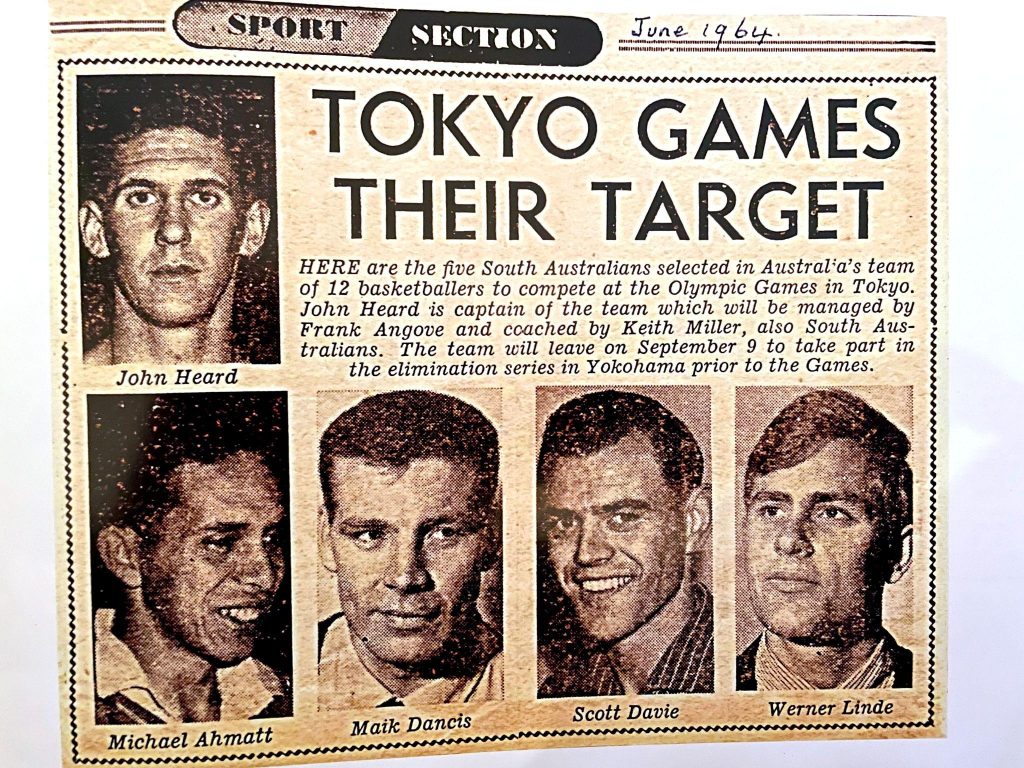
His performances at the 1964 Australian championship saw him selected for the Boomers’ landmark 1964 team which competed at the Tokyo Olympic Games.
It was no easy ride either as Australia’s part-timers won their way through the pre-Olympic qualifying tournament, then finished a very credible ninth at the Olympics.
Additionally winning the Church of Christ Association’s best and fairest player award five times. Scott coached multiple Church Basketball teams, fostering the talents of South Australia’s youth, including fellow Hall of Famer and Olympian Darryl Pearce.
Post-playing days, Scott stayed involved at the highest levels as team chaplain of the Adelaide 36ers’ NBL team from 1992 to 2006.
South Adelaide retired his famous #5 uniform in honour of his extraordinary service and contribution to his beloved Panthers club and when the famed Apollo Stadium closed its doors after being Australia’s premier basketball venue from 1969 to 1992, Scott Davie was named in the top 10 men’s players to ever compete at the historic venue.
18th – 21st May 2023
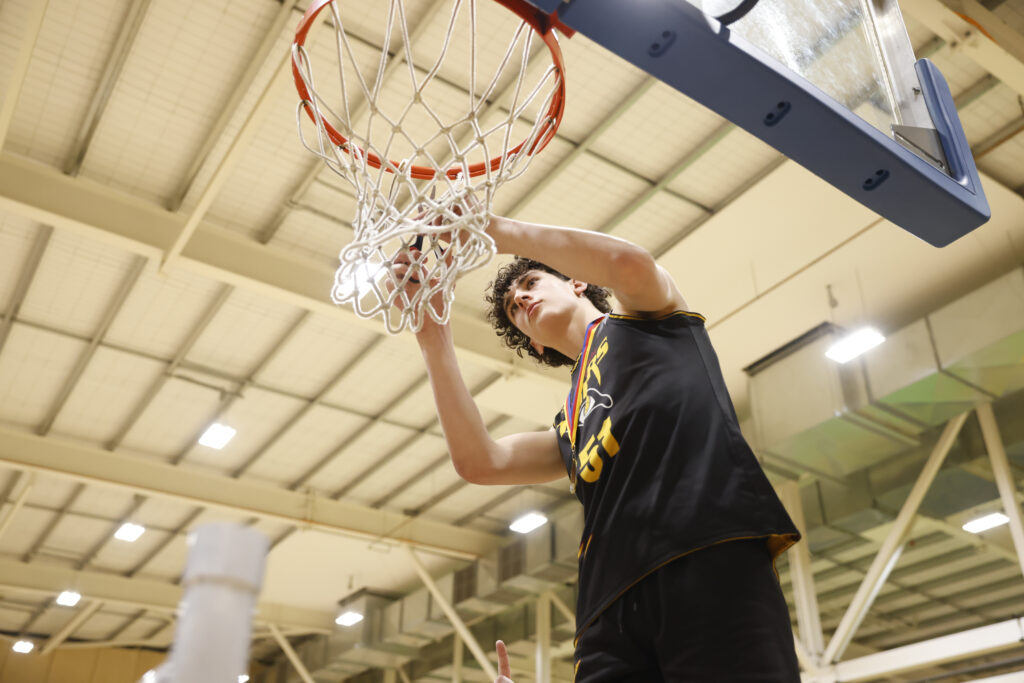
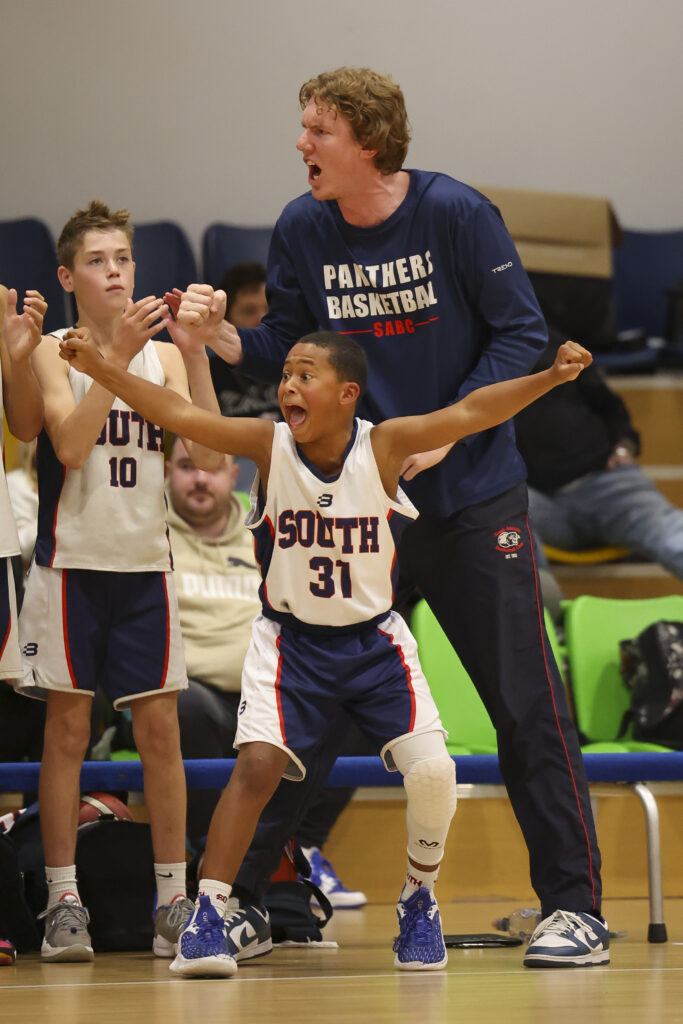
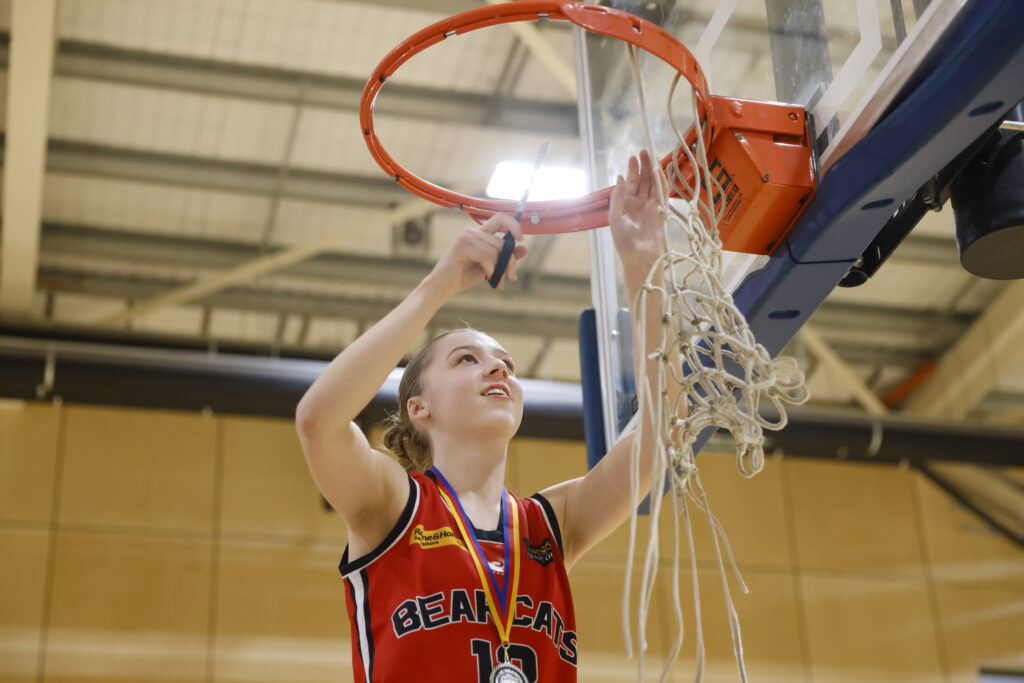
South Australia’s basketball scene was set ablaze over the weekend as the highly anticipated State Championships took place. The tournament brought together talented athletes from across the state for an unforgettable display of basketball.
Over the weekend, there was an undeniable buzz of excitement in the air as our Div 1 and 2 teams from the U12, U14, U16, and U18 age groups proudly represented their clubs at various venues. Throughout the tournament, spectators were treated to an impressive display of athleticism and sportsmanship, cheering on their favourite teams, creating an electric atmosphere throughout the entire tournament. The matches were a testament to the level of skill and talent present in South Australia’s basketball community.
We sincerely thank the referees and officials for their crucial role in the success of the State Championships. Their commitment ensured fair games and maintained the integrity of basketball. We greatly appreciate their contributions and unwavering dedication to the sport.
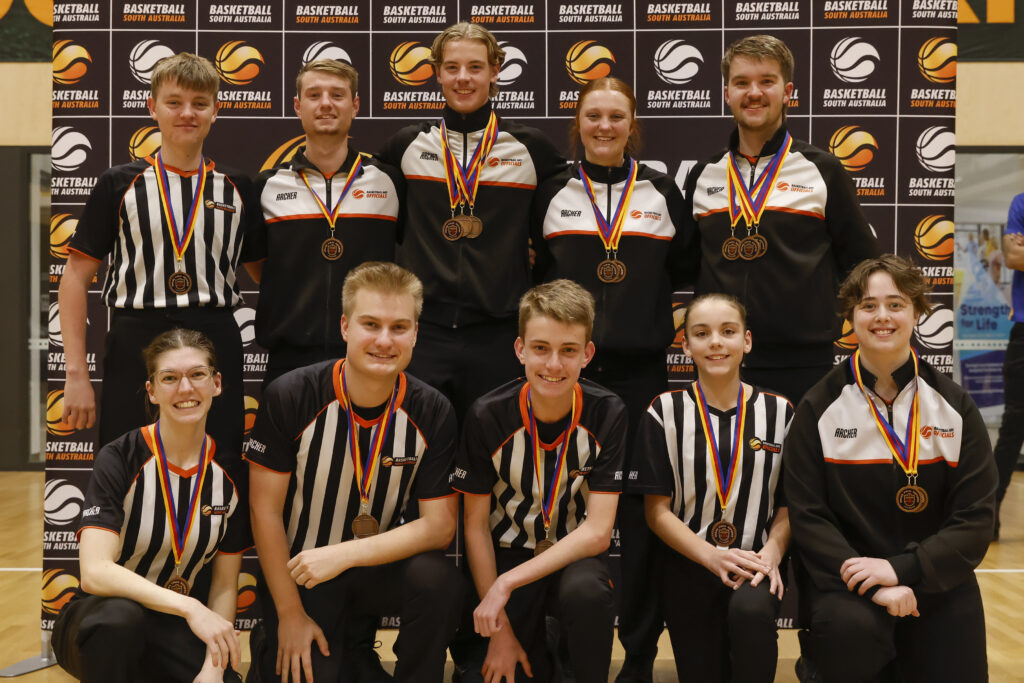
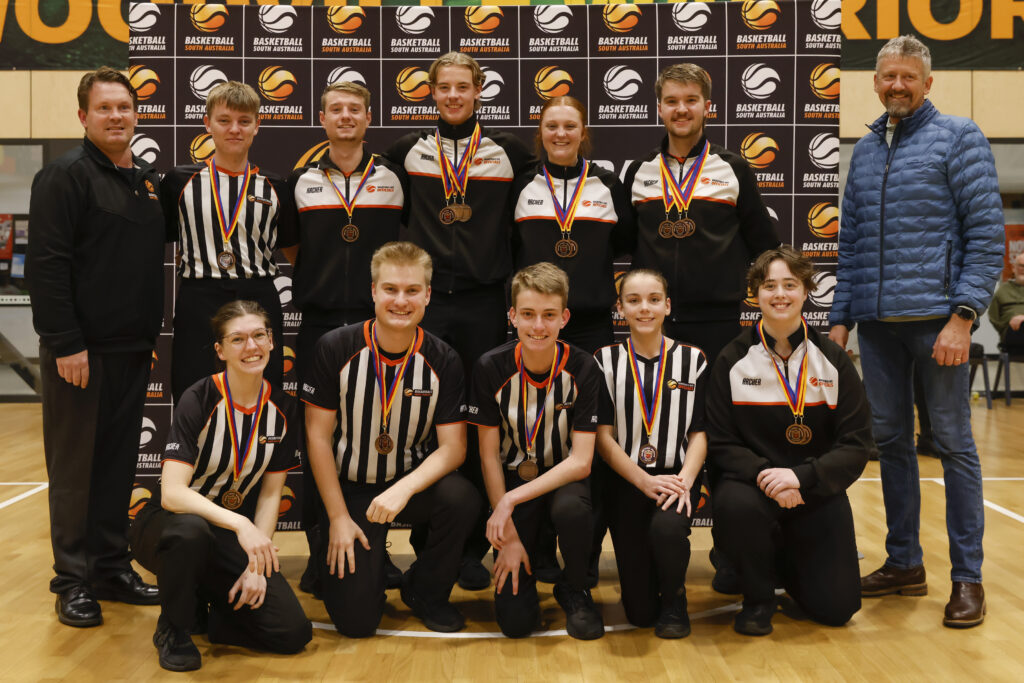
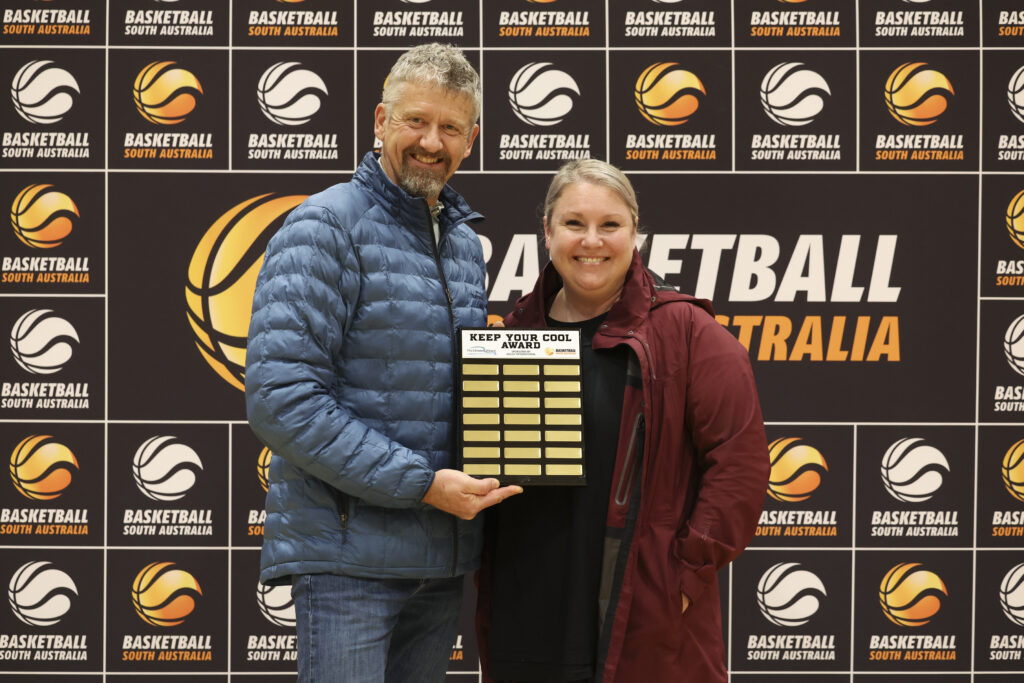
The 2023 Junior State Championships marked a significant milestone with the introduction of the highly esteemed Seeley International ‘Keep Your Cool’ award, proudly presented by Basketball South Australia’s corporate partner and sponsor of the referees and technical officials, Seeley International.
The award is determined by six key categories:
It is with great honour that we congratulate the Eastern Mavericks Basketball Club for their well-deserved recognition as the recipients of this award; presented by Managing Director of Seeley International, Jon Seeley. The Eastern Mavericks’ received the best score on the above criteria, demonstrating a commitment to fair play, respect, and sportsmanship. The award will be a perpetual trophy, symbolising the importance of these values in all our games.
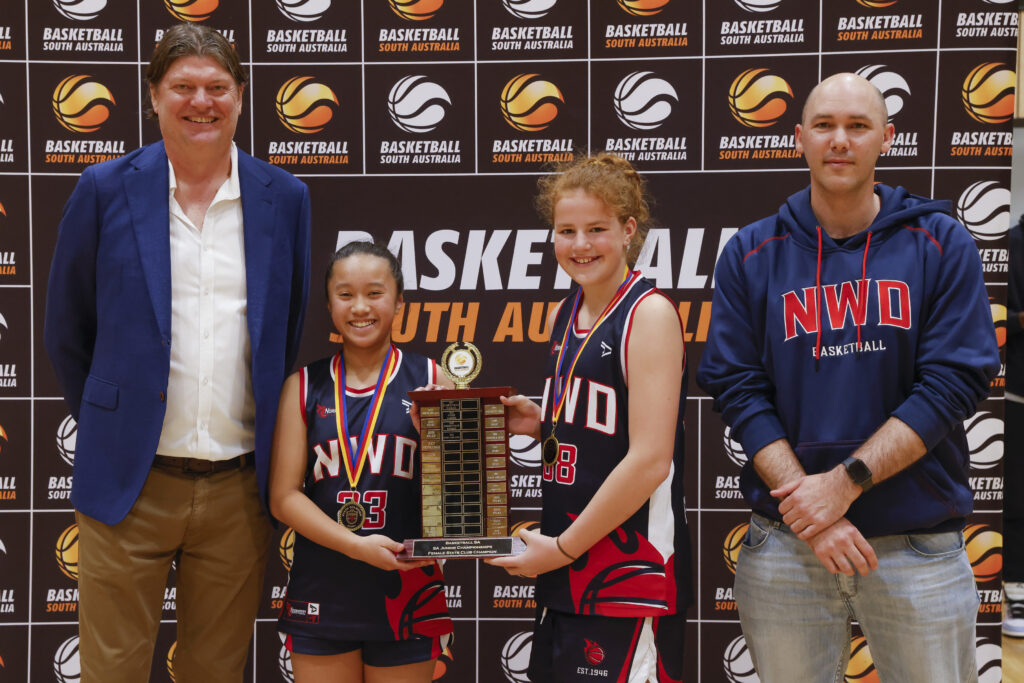
Congratulations to the outstanding teams who emerged as the overall champions of State Championships.
State Male Club Champion – South Adelaide
State Female Club Champion – Norwood Flames
Overall State Club Champion – Norwood Flames
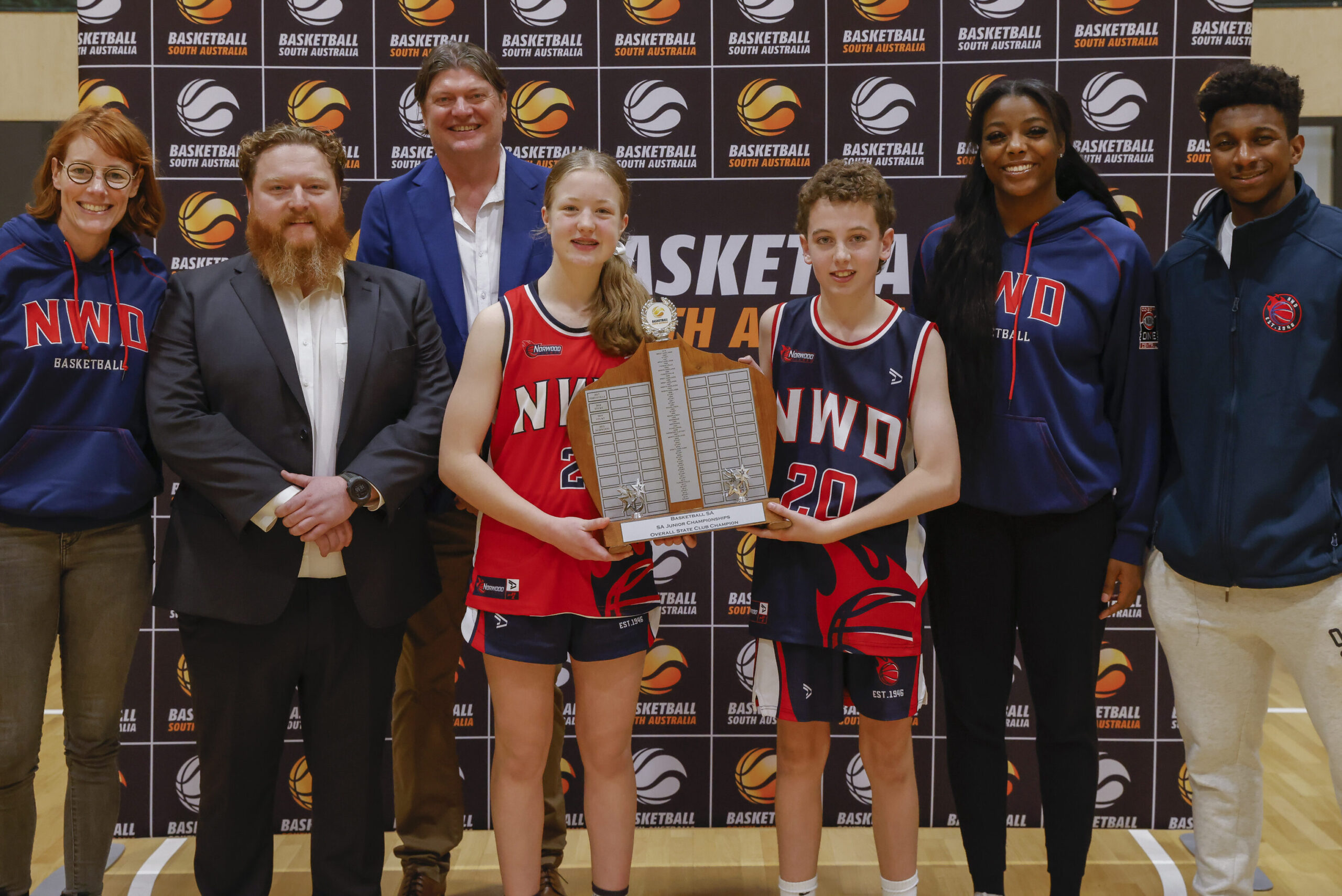
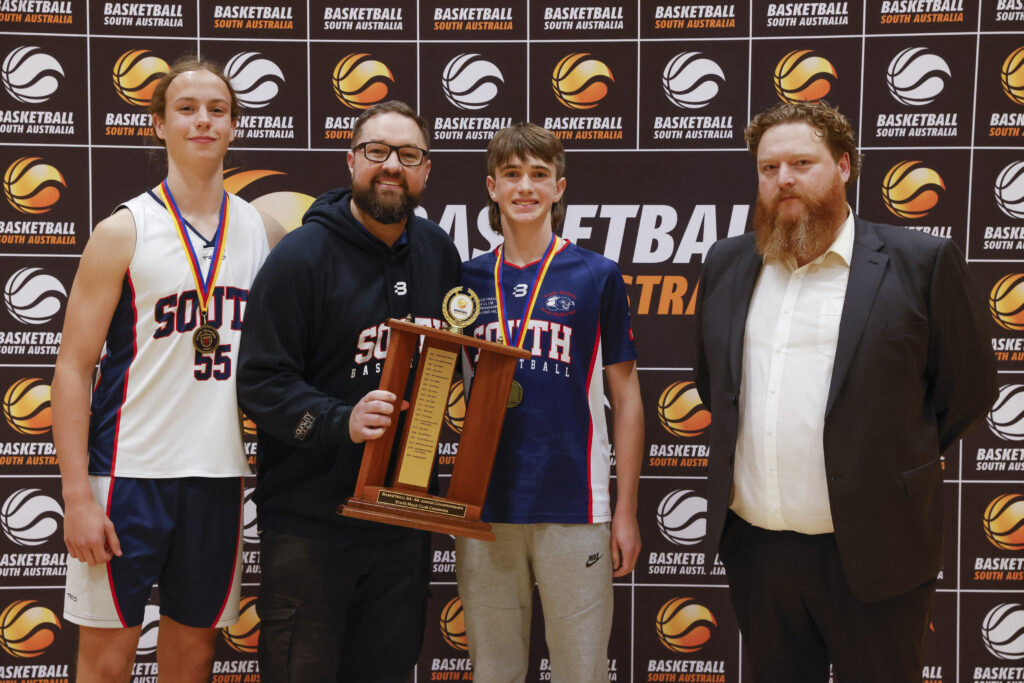
Reserve Male Club Champion – Sturt and South Adelaide
Reserve Female Club Champion – Forestville Eagles
Overall Reserve Club Champion – Forestville Eagles
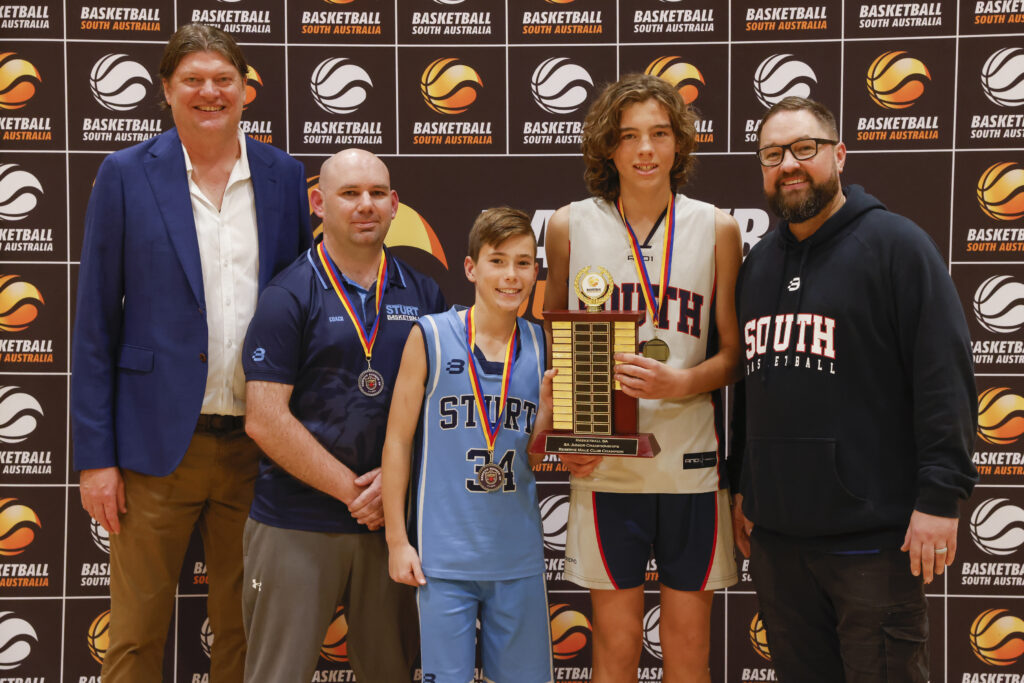
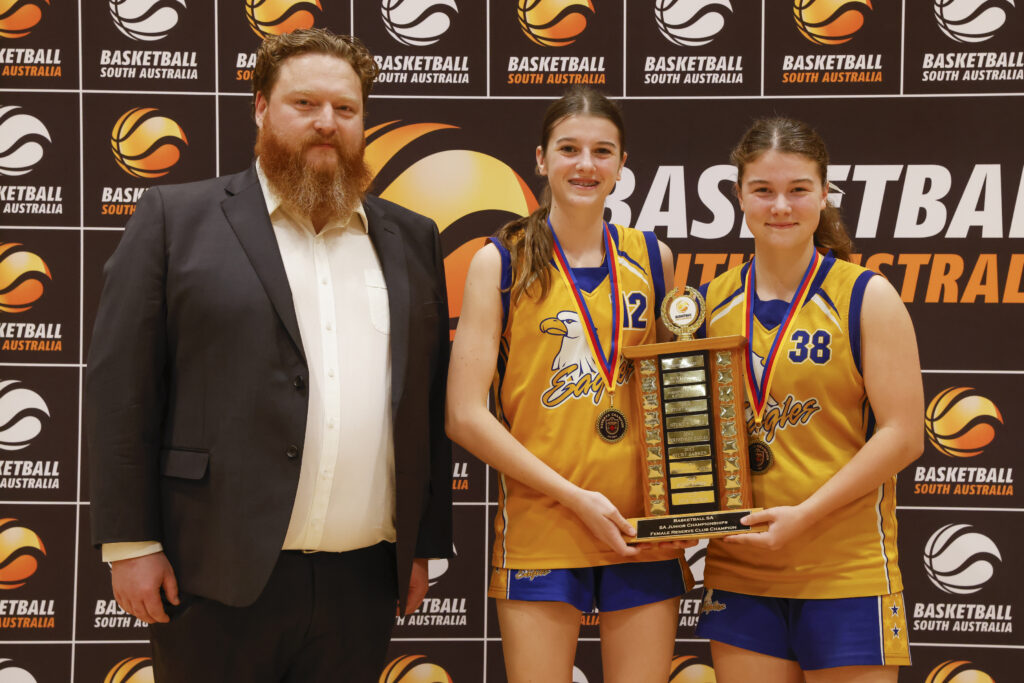
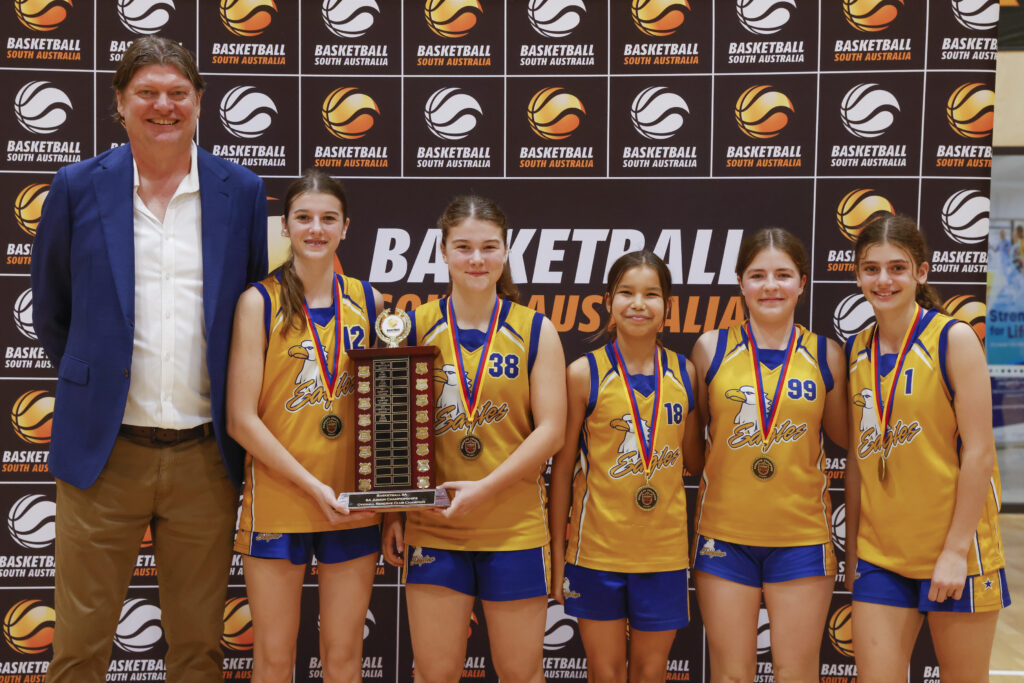
BSA Extends our congratulations to the following teams for their outstanding achievements in winning the State and Reserve State Champs Grand Finals.
Under 18 Boys State: Southern Tigers
Under 18 Girls State: West Adelaide
Under 18 Boys Reserve: Forestville Eagles
Under 18 Girls Reserves: West Adelaide
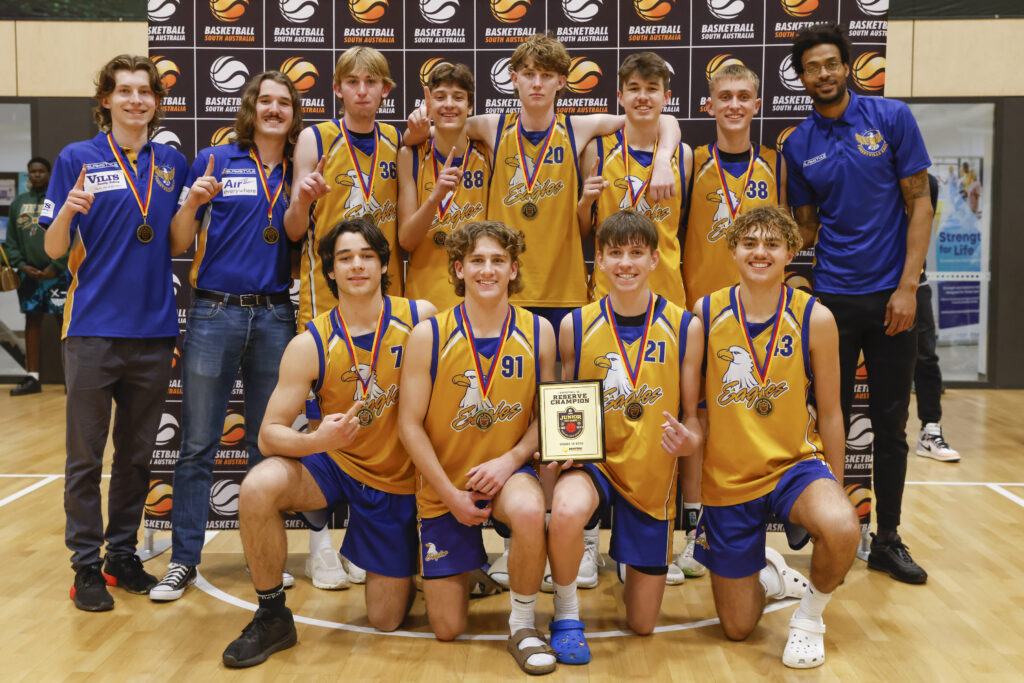
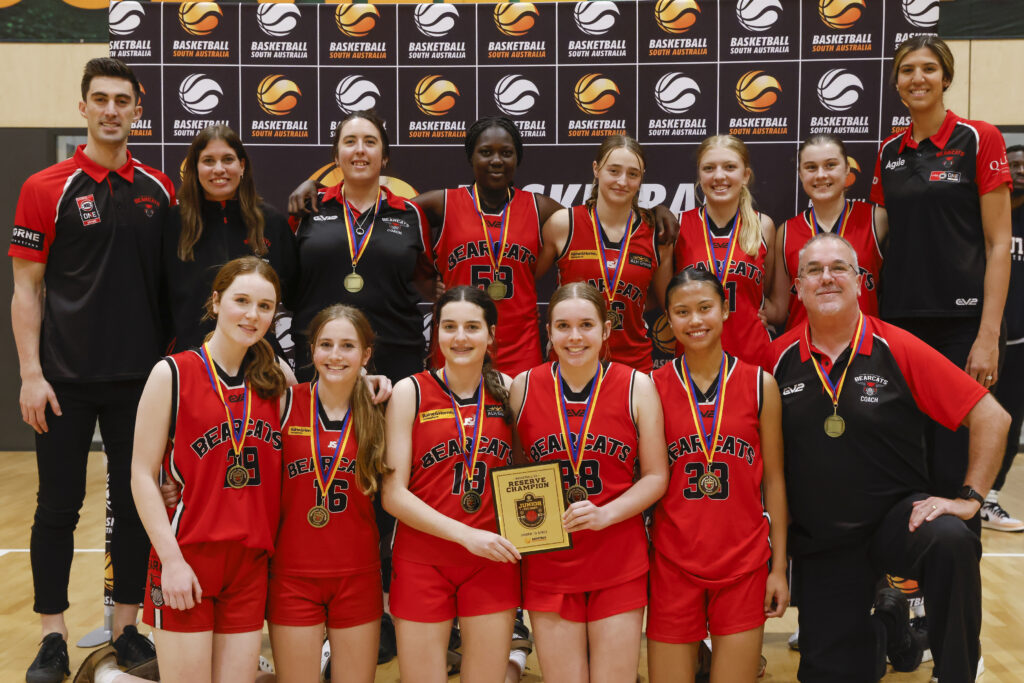
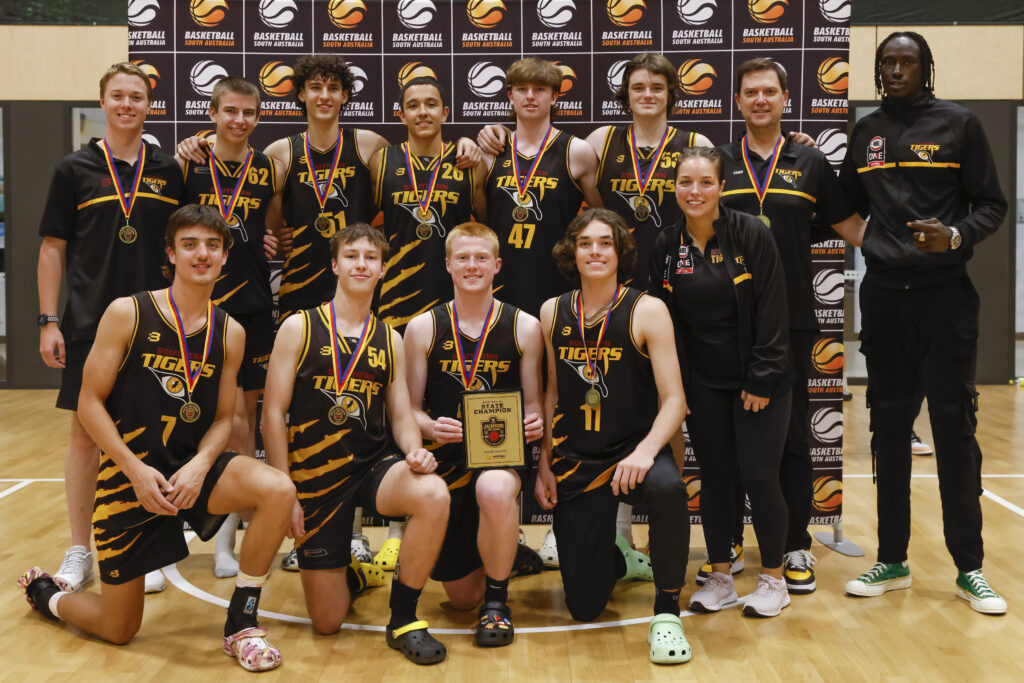
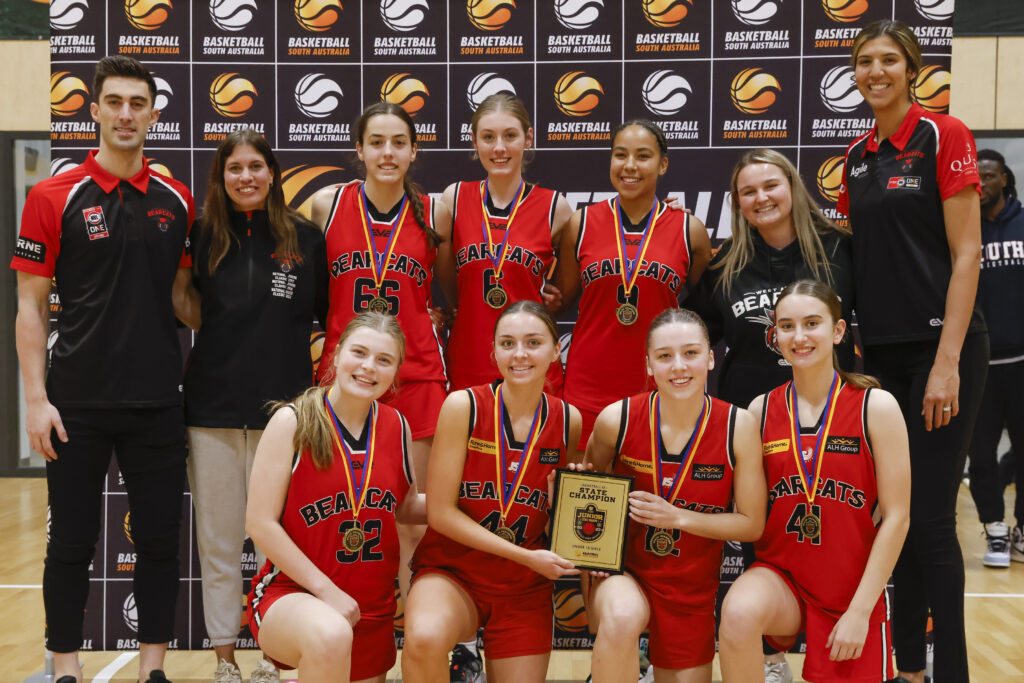
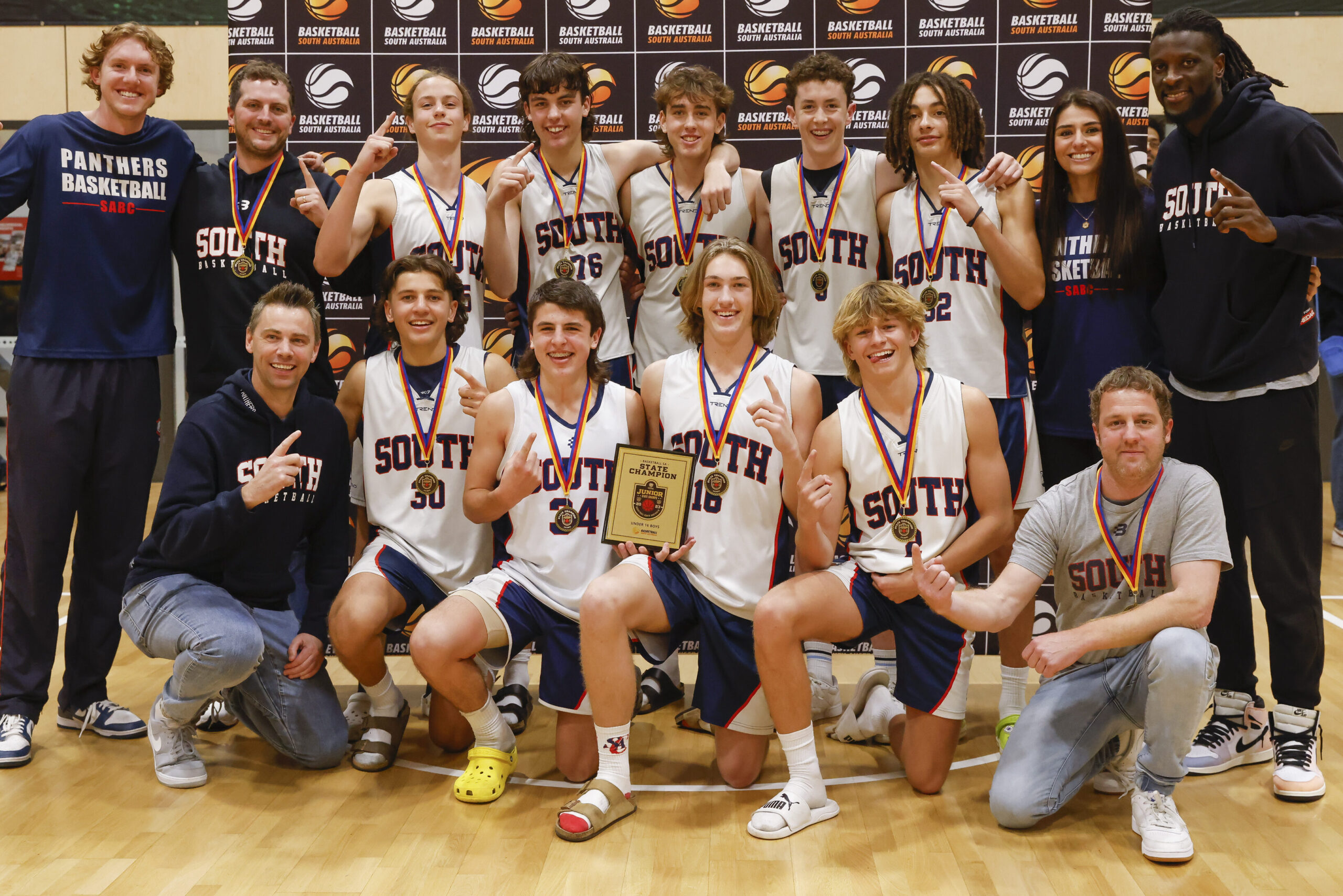
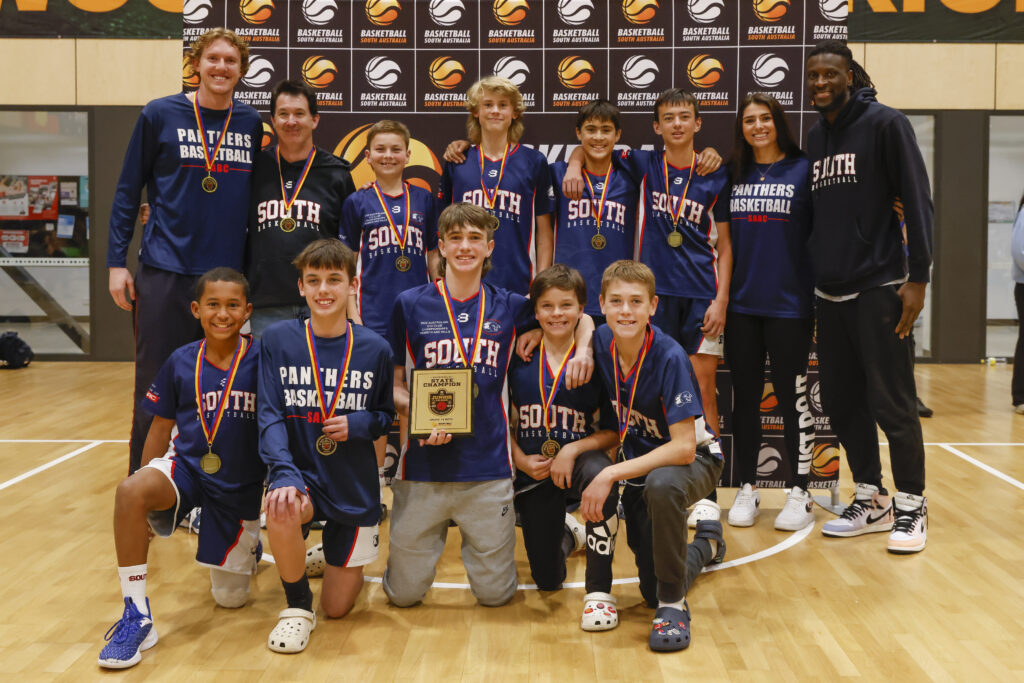
Under 16 Boys State: South Adelaide
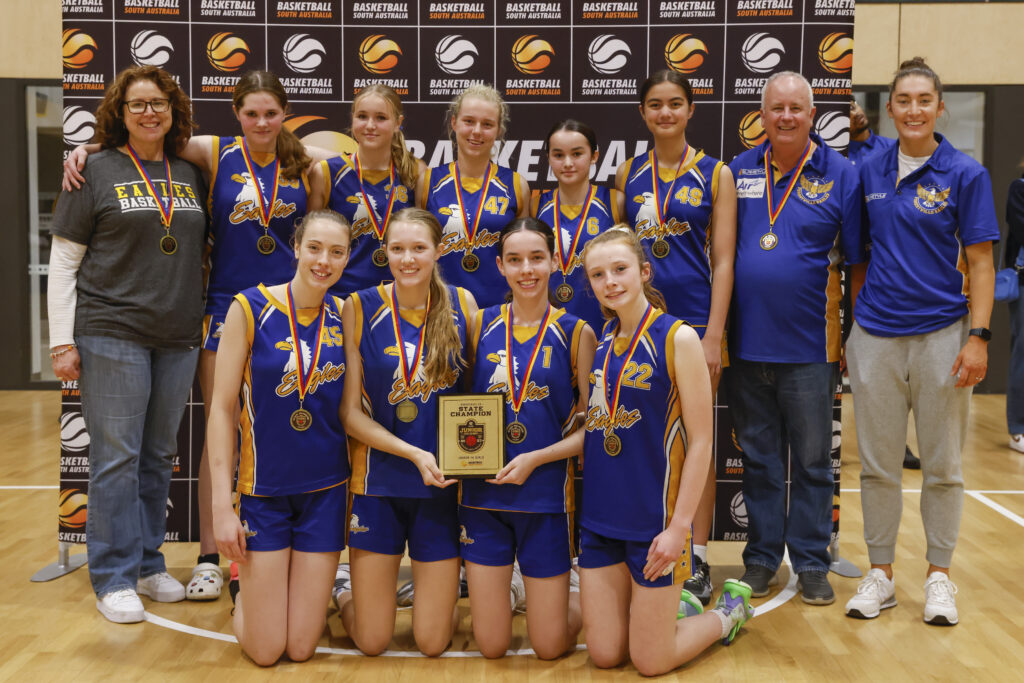
Under 16 Girls State: Forestville Eagles
Under 16 Boys Reserve: South Adelaide
Under 16 Girls Reserves: Forestville Eagles
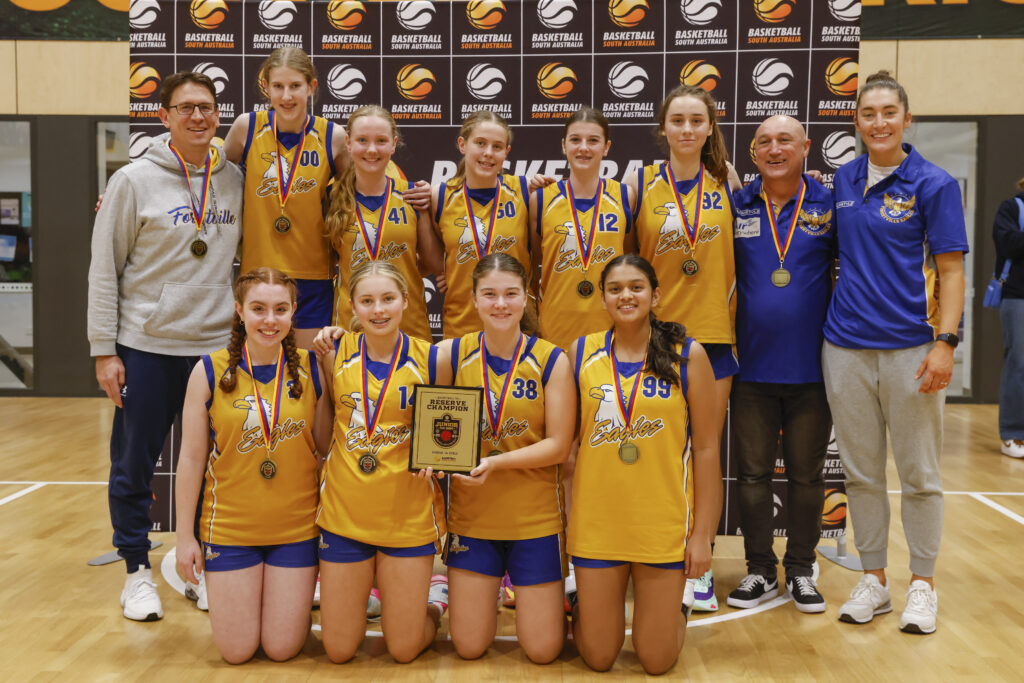
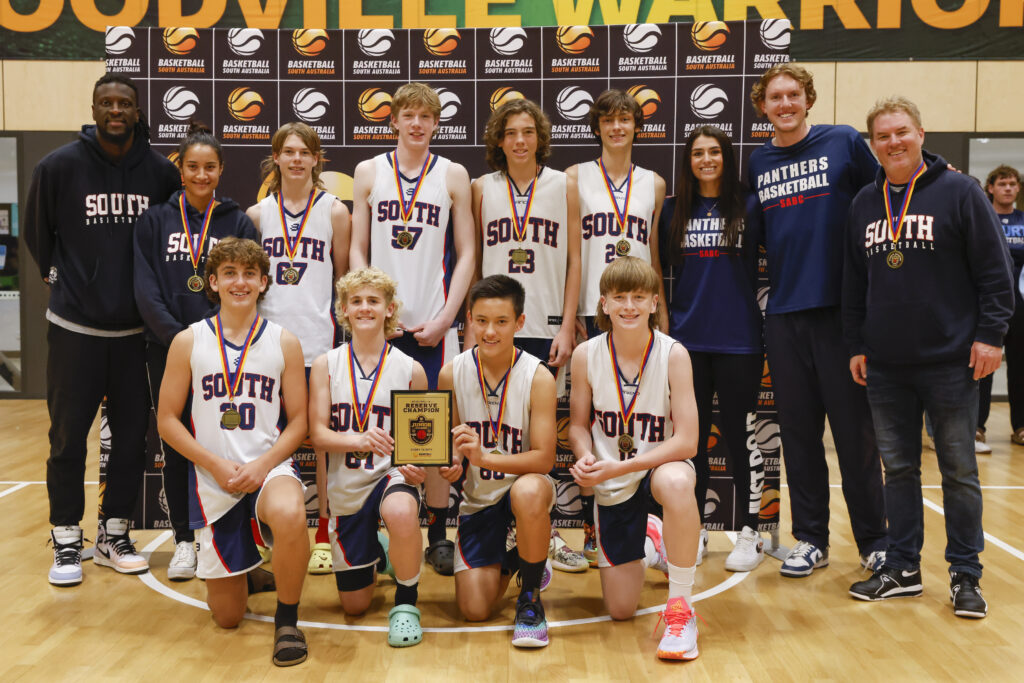
Under 14 Boys State: South Adelaide
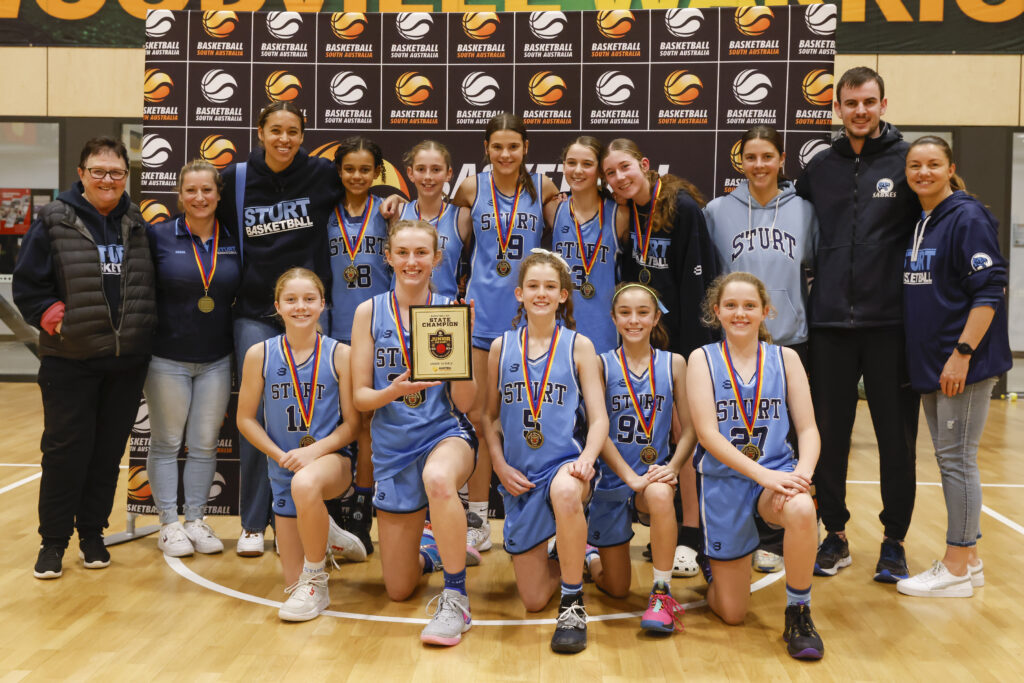
Under 14 Girls State: Sturt Sabres
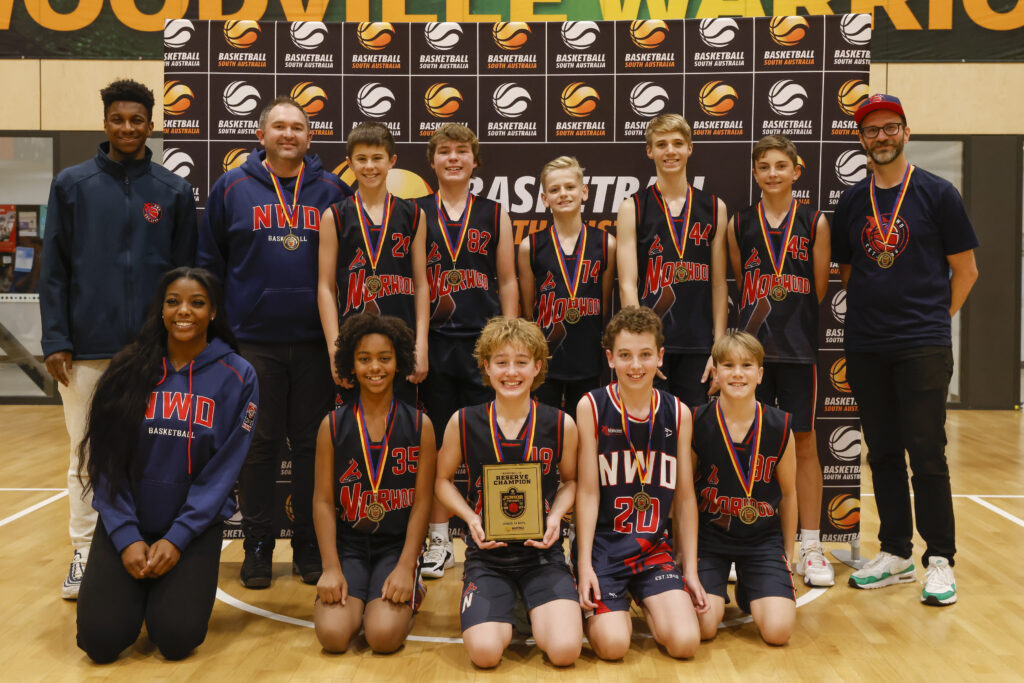
Under 14 Boys Reserve: Norwood Flames
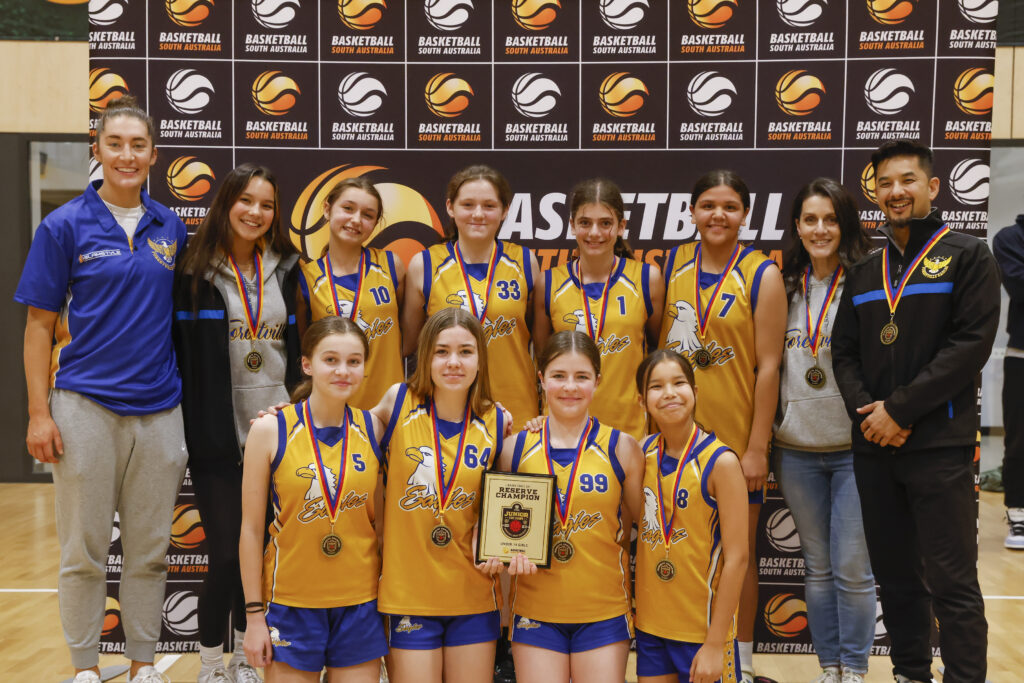
Under 14 Girls Reserves: Forestville Eagles
Under 12 Boys State: North Adelaide
Under 12 Girls State: Norwood Flames
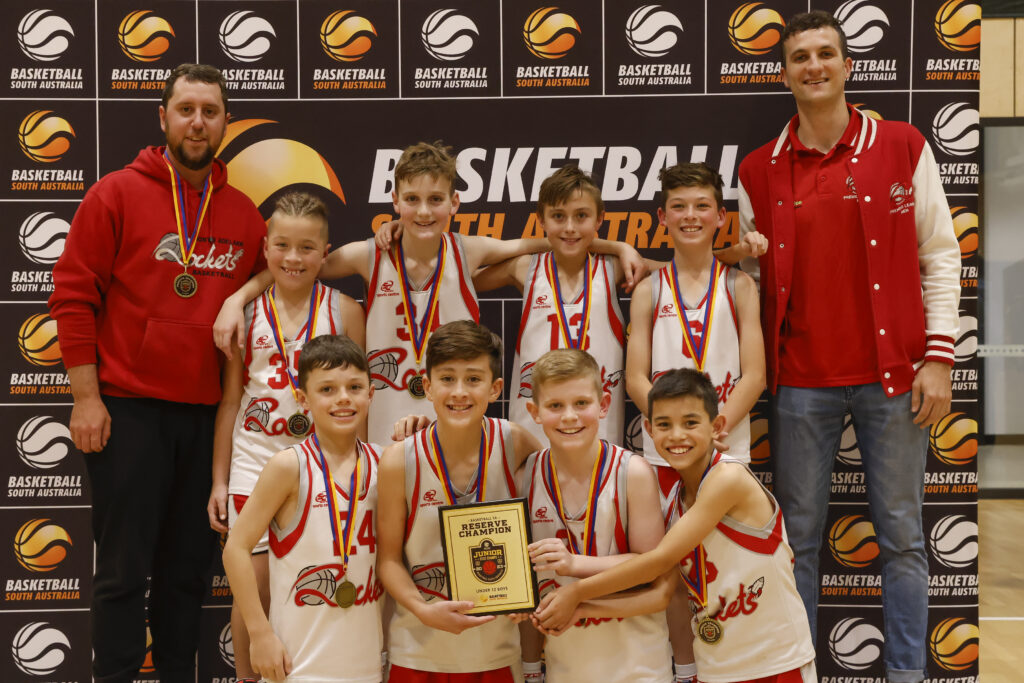
Under 12 Boys Reserve: North Adelaide
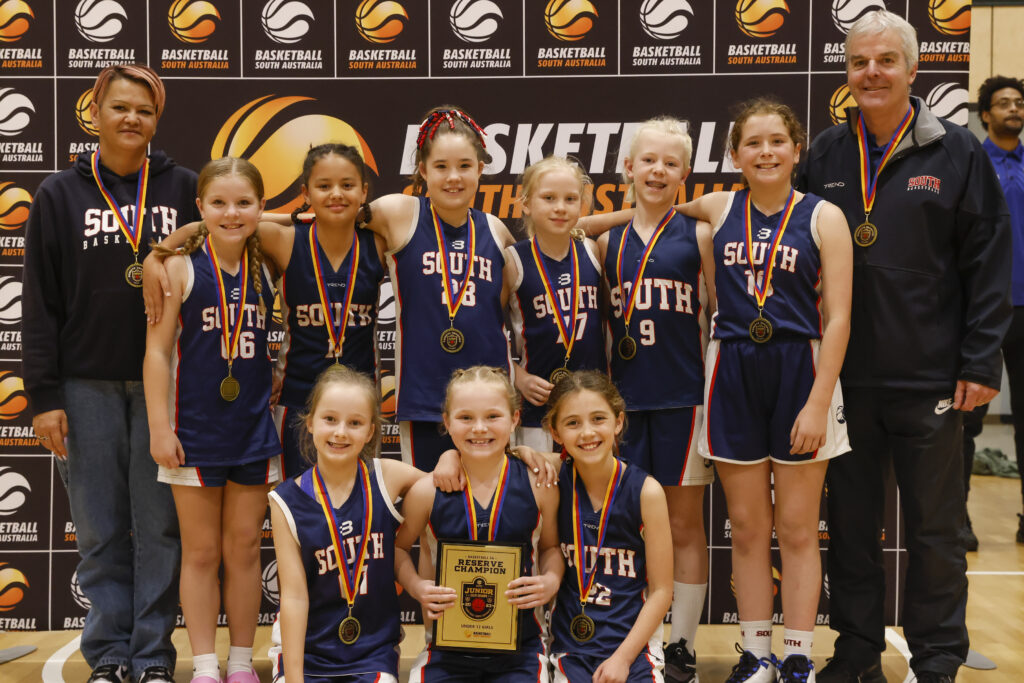
Under 12 Girls Reserves: South Adelaide
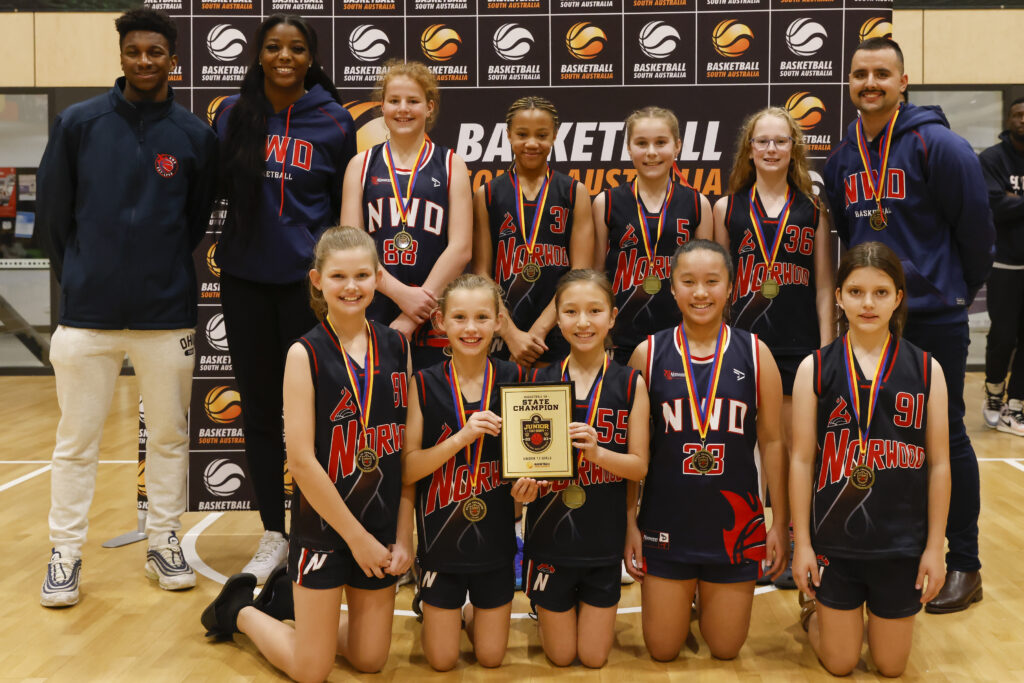
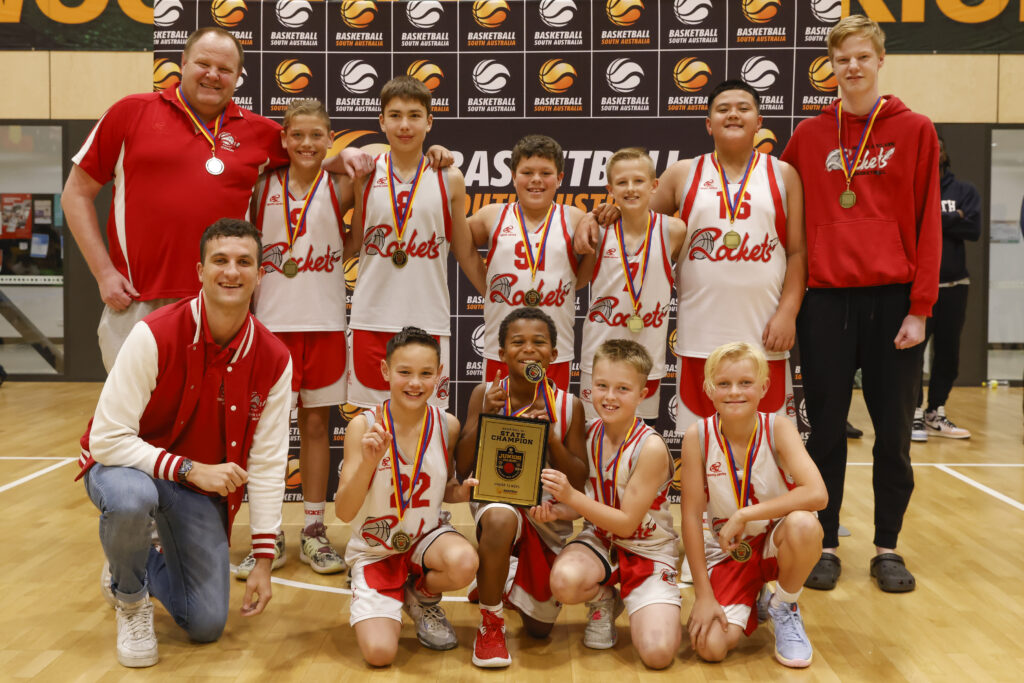
We congratulate all participants of the Junior State Championships for their exceptional skills, determination, and sportsmanship. Your involvement greatly contributed to the success of the event, whether as players, coaches, referees, or supporters. Your presence added to the competitive atmosphere and made the tournament memorable. We commend your efforts, sportsmanship, and commitment to the sport, showcasing the talent and passion within the basketball community in South Australia. Bring on 2024!
Basketball SA is thrilled to announce the signing of Seeley International as a Corporate Partner.
Seeley International is an Adelaide based company and a world leader in evaporative air conditioning solutions. Their indirect evaporative solution, Climate Wizard, boasts advanced technology to cool large areas while maintaining low running costs, providing exceptional ventilation, and preventing increased humidity.
Our partnership will recognise Seeley International as the preferred supplier for future Basketball SA facilities planning, as well as see Seeley International named as the Referees and Officials partner for Basketball SA. An exciting aspect to our partnership will be a Climate Wizard solution installed in the State Basketball Centre currently under construction at Wayville.
Basketball SA CEO, Tim Brenton, said they are looking forward to working with Seeley International to showcase Climate Wizard in the new Home of South Australian Basketball as the best air conditioning solution for the sport.
“The upfront cost and ongoing running expenses for all community sports are a huge consideration, whilst balancing the need to keep the court area humidity levels low. Seeley’s Climate Wizard indirect evaporative solution does this, whilst also ensuring great ventilation. 100% of the circulated air is sourced outside, which we recognise as an important benefit to basketball following the impacts of Covid-19 to the sport.”
Jon Seeley, Group Managing Director of Seeley International, said he was pleased to be working with such an inclusive and diverse sport that has such a high reliance on the climate control of its venues, and hopes to keep working with Basketball SA in other venues.
“We know basketball is a very popular sport in the state, and we are excited to be working with Basketball SA to support referees and officials deliver the game and help everyone keep their cool. It’s fitting that our cutting-edge technology will be used to help provide perfect conditions for the game at the State Basketball Centre.”
To recognise Seeley International’s valued support for the high performance pathways of our referees to NBL1, National and International levels, the Climate Wizard logo will be seen on all NBL1 Central Referees and Officials uniforms during the 2023, 2024 and 2025 Seasons.

Basketball SA is proud to announce the appointment of Bailey Dyer to the WNBL Referee Panel. The panel currently consists of five South Australian Officials.
We sat down with Bailey to chat about what this appointment meant to him and the advice he would offer to aspiring officials:
“This opportunity to officiate in the WNBL was not something I expected to happen so quickly. This appointment means the world to me, and all the hard work put into games, tape review, physical ability and presentation are paying off. I hope for this to be the beginning of a continued career in basketball officiating and the start of a pathway to the best leagues in Australia and the world.”
“My advice to young aspiring officials is to work hard on and off the court, understand the game, take any opportunity for development that is thrown your way, and never get ahead of yourself or take anything for granted. If you work hard, put in the time, and know your stuff, the time will come!”
Referee Framework and Services Manager, Phil Haines couldn’t be prouder of Bailey’s achievement, “Bailey being appointed to his first WNBL game is a well-deserved reward for all the hard work and dedication he puts into his officiating. He has travelled the referee pathway in South Australia from juniors to attending the Australian Junior Championships, working senior leagues including the NBL1, and becoming a member of the NRDP. This is an important step in his continued development that will no doubt see him achieve his future goals as an elite official.”
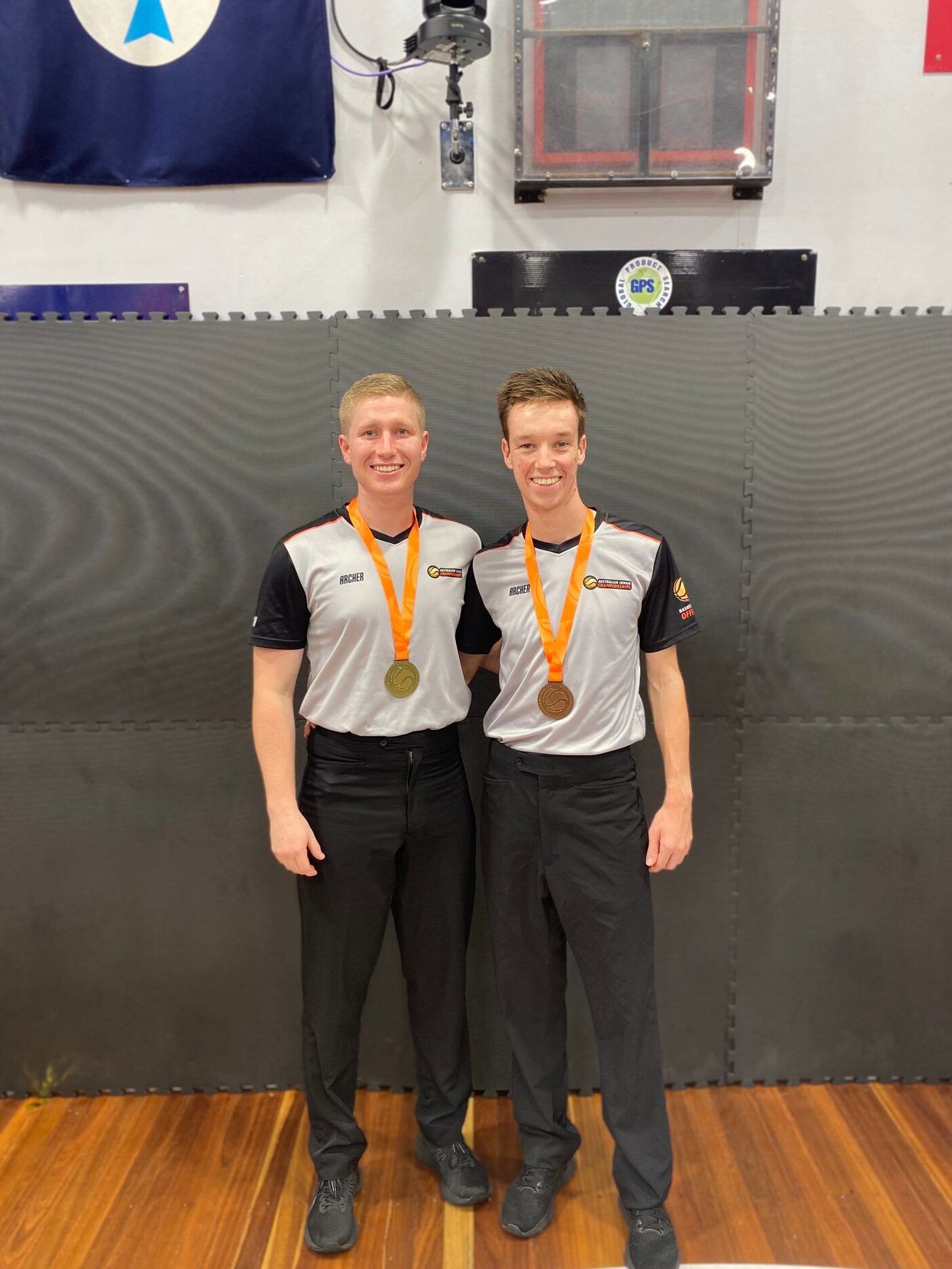
Bailey Dyer picture left with fellow referee Nathan Davis.
RULE CHANGES
“Throw-in foul” and removal of C5 USF (Article 34 / 37)
Rule: 34.1.2 – A throw-in foul is a personal foul committed, when the game clock shows 2:00 minutes or less in the fourth quarter and in each overtime, by a defensive player on an opponent on the playing court when the ball is out-of-bounds for a throw-in and still in the hands of the referee or at the disposal of the player taking the throw-in.
The rule which previously governed the fifth criteria of unsportsmanlike fouls is no longer an automatic unsportsmanlike foul. What shall be called in this situation is a normal defensive foul with modified penalties – a “Throw-In Foul” shall be called instead.
A “Throw-In Foul” will result in one free throw for the player fouled and possession of the ball at the nearest point to where the foul occurred – not the location of the original inbound unless this is the nearest point.
The “Throw-In Foul” will apply regardless of the defensive team being in the foul penalty situation. All “Throw-In Fouls” in the last two minutes of regular and overtime will be one free throw and possession of the ball at the nearest point to where the foul occurred. This may occur more than one time in a sequence and at multiple times during the last 2 minutes.
Note: This does not mean unsportsmanlike fouls cannot be called in the last two minutes on a throw-in. The normal conditions for unsportsmanlike fouls may still be applied to players that deliberately grab an opponent or foul excessively.
Video example: https://youtu.be/0egtziuSDGw
C4 USF clarification
Rule: 37.1.1 (4th Bullet) An illegal contact caused by a player from behind or laterally on an opponent, who is progressing towards the opponent’s basket and there are no other opponent players between the progressing player and the basket, and
– The progressing player is in control of the ball, or– The progressing player is attempting to gain control of the ball, or – The ball has been released on a pass to the progressing player.
This applies until the offensive player begins the act of shooting.
Video example: https://youtu.be/e-v_5J9jgbE
SIGNAL CHANGES
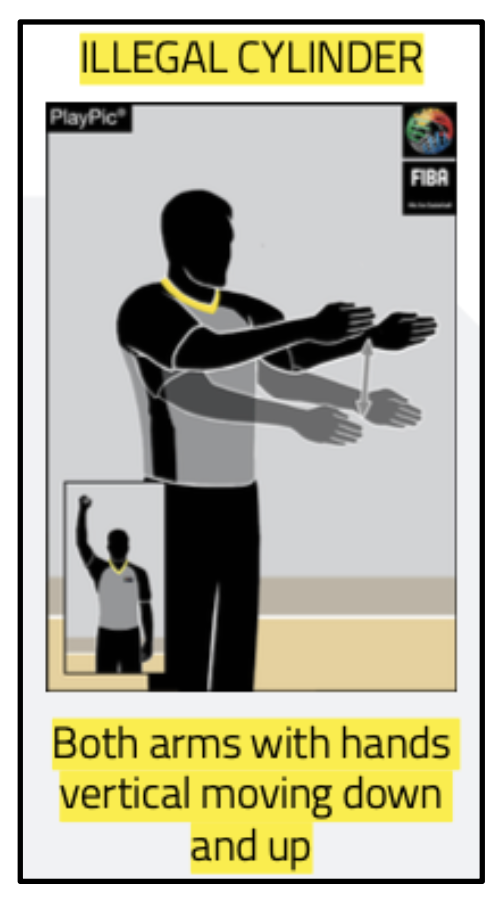
Illegal Cylinder
This signal is used to demonstrate the specific action of a cylinder foul. The foul call itself can create confusion in the game as to why it was called and thus this signal endeavours to explain the nature of the cylinder foul.
Note: Although this is a new, FIBA-approved signal it is not recommended for use when reporting to the score table. A blocking or pushing foul are typically more descriptive and more accurate representation of actions that occur on the floor.
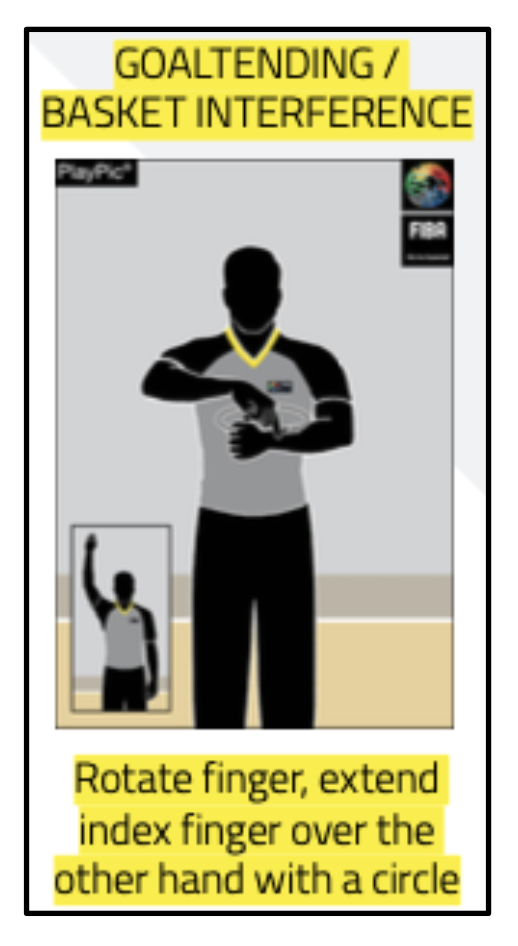
Goal tending / Basket interference
This signal is used to clarify what the referees’ decision is on the floor and why the basket will count or not, in a way explaining the violation to the game without need for excessive, unapproved hand gestures.
When executing the new signal following a goaltending or basket interference call, referees must use 3 different signals in the following order for uniformity and consistency of application:
1. Blow whistle and use stop the clock signal to stop the game.
2. Show the Goaltending/Interference signal.
3. Signal how many points shall count or if the basket will be cancelled
Video example: https://youtu.be/65PPNTIUTS8
ADDITIONAL
*There are no FIBA rule changes regarding the no-charge semi-circle, restricted area, or defensive semi-circle.
*There is a suite of FIBA rule changes from October 1, 2022. Although not all changes will apply to Basketball South Australia Competitions or directly to the officials on the floor, all Officials are expected to know these changes in full as part of their professional duty to the sport.
After an extensive national search, Basketball South Australia is excited to announce the appointment of Tim Brenton as CEO.
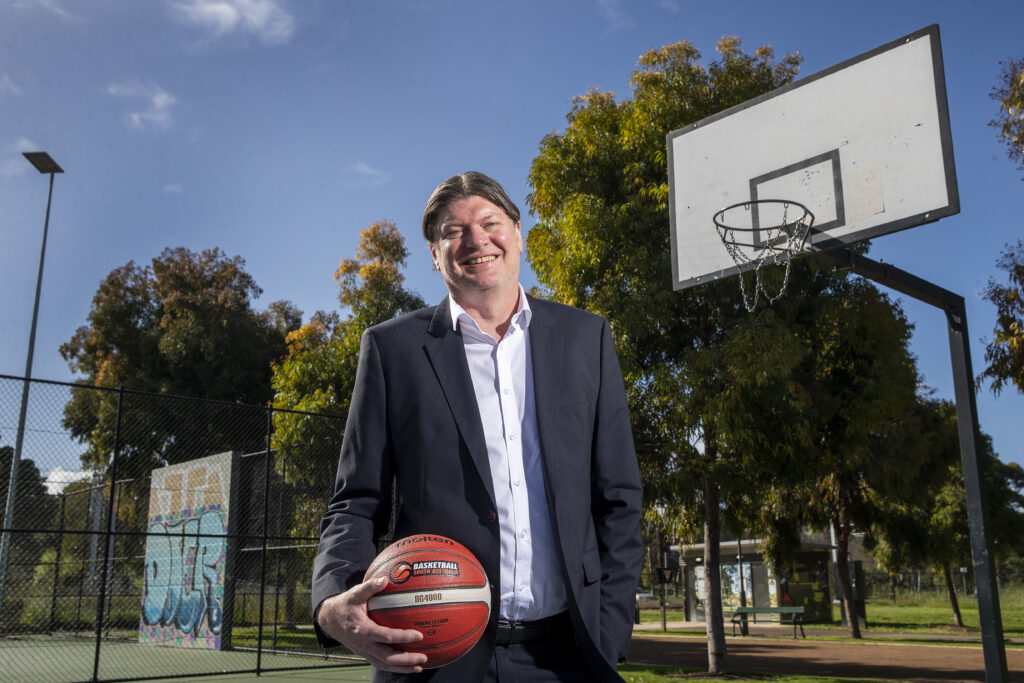
Tim joins Basketball South Australia after a successful career in the sporting industry most recently as the General Manager of Adelaide Lightning and before that as a consultant for Basketball South Australia.
Co-Founder of the Aboriginal Basketball Academy, and former NBL player, Tim will bring not only a business and politically savvy mindset but a wealth of relevant basketball knowledge and experience that is unparalleled.
Basketball South Australia Chairman, Wade Burns welcomes Tim to Basketball South Australia describing him as the ideal person to lead the organisation, “After conducting a national CEO recruitment search, Tim was identified as the ideal candidate from an exceptional list of applicants.”
“His depth of basketball expertise, across a multitude of roles and functions, coupled with demonstrable business achievements, ensures that Tim will lead Basketball South Australia with authority and credibility.”
The panel, including representatives of key stakeholder groups, believe Tim’s skills and personal attributes are exceptionally well suited to driving positive change to further enhance the sport of basketball, at all levels, within South Australia.
“With a high degree of professionalism, integrity, and self-awareness, Tim’s people-centric approach and genuine ability to build positive partnerships will hold him in good stead to lead Basketball South Australia into the future,” said Wade.
Tim is thrilled to be the new CEO of Basketball South Australia and is looking forward to elevating the sport in the state.
“I love everything about our sport, and I am looking forward to the opportunities on and off the basketball court.”
“Basketball has seen considerable growth over the last five years and most recently with the success of the Commonwealth Games Men’s and Women’s 3×3 teams and FIBA World Cup Opals Bronze medal, this is an exciting time to be part of the sport,” Tim said.
“I share a positive and strong connection with Basketball South Australia and the wider basketball community. I have the belief and confidence that I can oversee and lead all commercial activities as well as ensure all facets of the sport are improved across South Australia including facilities, membership, competitions, and stakeholder partnerships.”
Tim will commence as Chief Executive Officer on Monday, 31 October 2022.
Basketball SA inducted two new referees into the Basketball SA Officials Platinum League.
The Platinum League is recognising outstanding dedication, contribution, development and promotion as an official, an educator and ambassador in the sport of basketball throughout South Australia.
Congratulations to David Moir and Howard Nixon on being inducted into the Basketball SA Officials Platinum League.
Howard Nixon
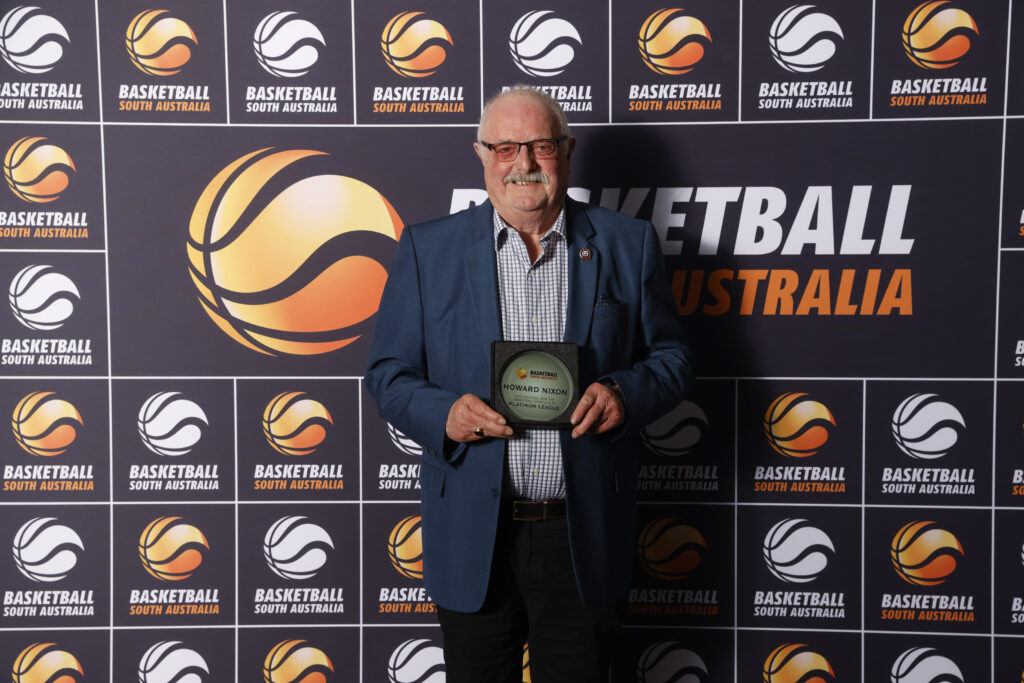
Statement of Career Achievements
State Referee Badge
Australian Badge 1973
FIBA Badge 1976
Numerous National Junior/Senior Championships
SA Rules Interpreter 1983-1988
Chair of the Referees’ Selection Committee
NBL Referee Coach 1983-2015 (includes time while out of SA)
Started Officiating in 1962, with his first Men’s District game in 1965 with David Moir
First Referee Life Member of Basketball SA 1983. (Now BSA Participant Life Member)
Refereed 2 Men’s District Men’s Grand Finals (Now NBL1 Central)
Appointed to every National Championship Final when a South Australian team was not in the Final. Neutrality of Officials was the rule during much of Howard’s officiating caree
Officiated a number of International matches involving various South Australian State and Club teams against visiting teams
David Moir
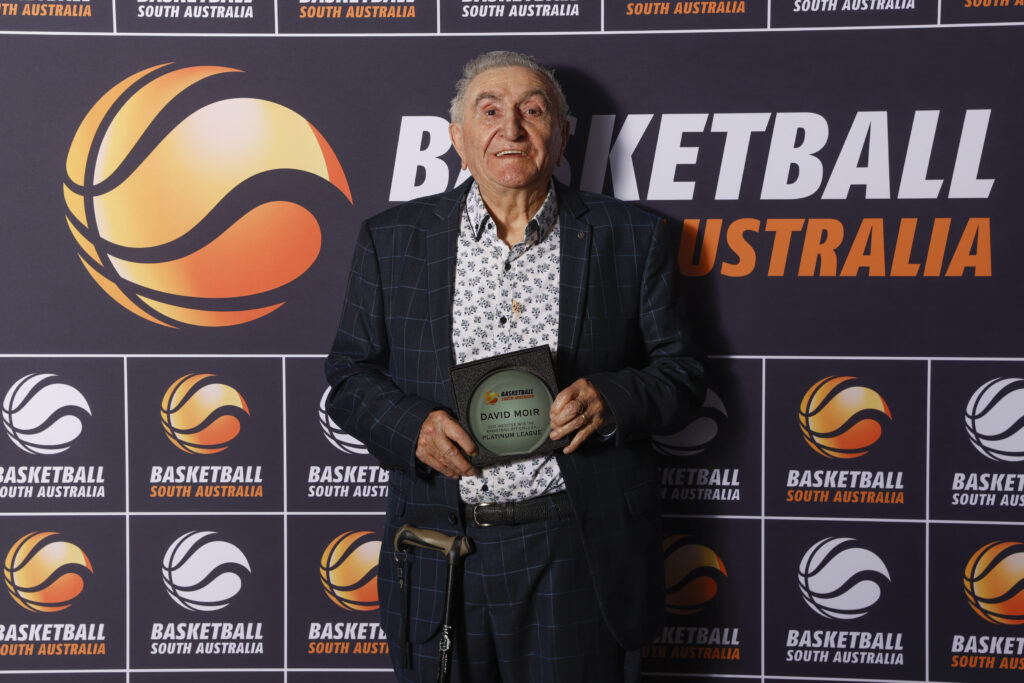
Statement of Career Achievements
State Referee Badge
Australian Badge 1970
FIBA Badge 1972
Awarded Life FIBA 1982
Numerous National Junior/Senior Championships
Asian Games over 10 years
FIBA Women’s World Championship Columbia
SA Rules Interpreter 1975-1980
Umpires’s Coach and Member of the State Standard Committee